




Strict-R Inducible CRISPRa Lentiviral System
How it works
System OFF: In the absence of doxycycline and Shield1, the system remains inactive. Any residual transcription from the TRE3G promoter produces degron-tagged dCas9-VPR, which undergoes rapid proteasomal degradation, minimizing unintended background activation.
System ON: Doxycycline administration activates the Tet-On 3G transactivator, inducing robust dCas9-VPR expression. Shield1 addition stabilizes the expressed dCas9-VPR protein, allowing accumulation and precise gene activation.
Schematic map of the Strict-R Inducible Lentiviral CRISPRa vector
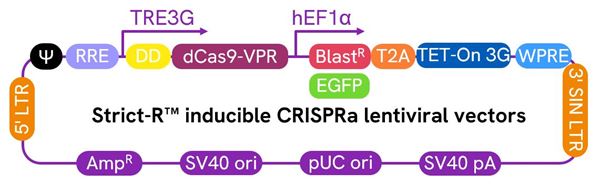
Transcriptional and post-translational control with the Strict-R Inducible Lentiviral CRISPRa System
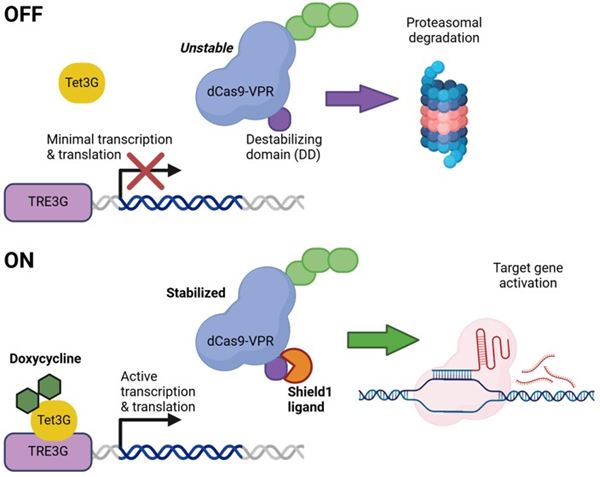
Diagram of the Strict-R Inducible Lentiviral CRISPRa System. In the absence of Doxycycline and Shield1, the system is “OFF”. Leaky bursts of transcription from the TRE3G promoter result in the translation of dCas9-VPR fused to a FKBP12-derived destabilizing domain (degron) that tags the protein for rapid proteasomal degradation . The addition of doxycycline induces potent transcription from the TRE3G promoter and the addition of Shield1 stabilizes dCas9-VPR thereby enabling robust target gene activation in the presence of a gene-specific sgRNA. Diagram created with BioRender.com.
Highlights
- Achieve reversible, small molecule-induced activation of target genes, providing tight regulation of gene expression.
- The dCas9-VPR fusion protein maximizes transcriptional activation with minimal off-target effects.
- The integration of the Tet degron system allows for rapid induction of dCas9-VPR expression upon the addition of doxycycline and Shield1, facilitating dynamic, time-controlled experiments.
- This system is expressed from a single lentiviral vector facilitating integration into your experimental workflow.
- Enables wide range of research applications including gene expression studies, functional genomics, and potential therapeutic applications.
- High quality, purified lentiviral particles for direct transduction with minimal cytotoxicity; delivered at titers of ≥ 1 x 10⁷ TU/mL
- Options for either Blastacidin selection or EGFP fluorescent reporter.
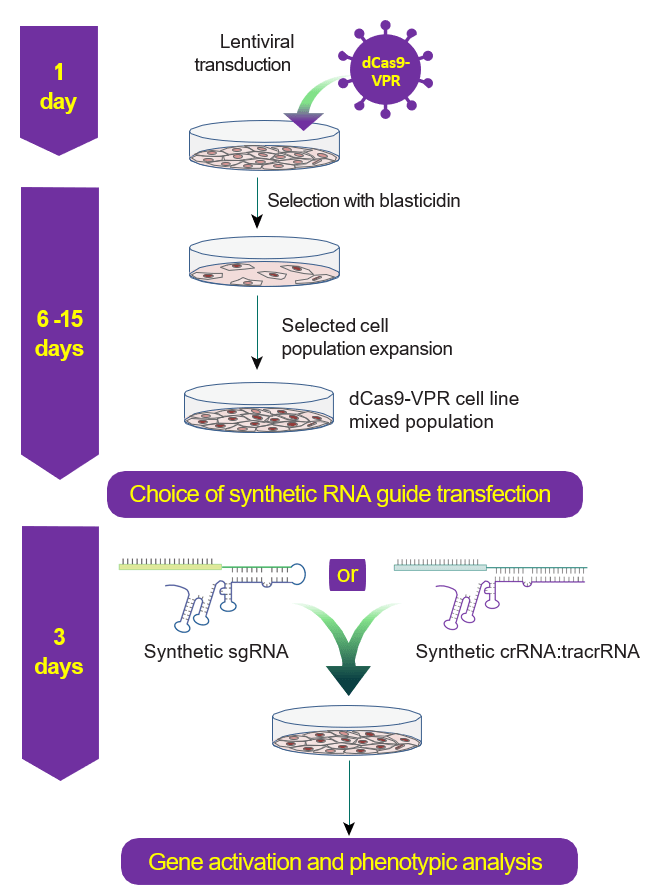
CRISPRa workflow diagram with stable dCas9-VPR expression

CRISPR activation workflow with Lentiviral dCas9-VPR and synthetic crRNA:tracrRNA (right side) or Lentiviral expressed sgRNA (left side).
Tighter control of CRISPR activation with the Strict-R Inducible Lentiviral CRISPRa System
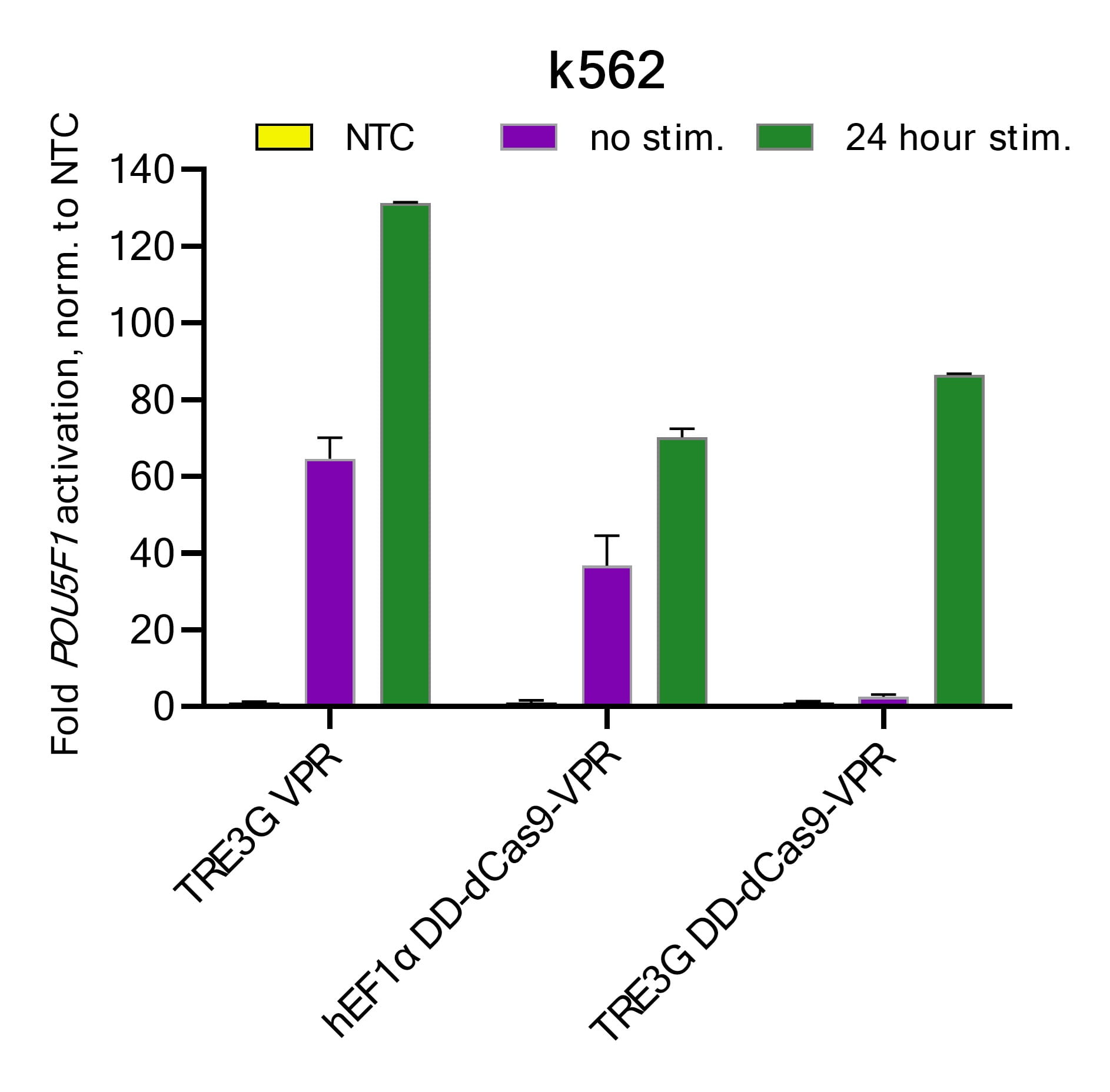
Figure 1: K562 cells were transduced with lentiviral particles containing the respective dCas9-VPR constructs at MOIs <0.3. Cells were selected with 10 µg/ mL blasticidin for two weeks with passaging every 3 to 4 days. After blasticidin selection, stable cell lines were transduced with either a CRISPRmod CRISPRa lentiviral sgRNA targeting POU5F1 or a CRISPRmod CRISPRa lentiviral non-targeting control (NTC) at MOIs of 0.3. After 48 hours, cells were selected with 2.5 µg/µL puromycin for 5 days. Cells were plated in 96-well plates at 20,000 cells/well and stimulated with 0.5 µg/ mL doxycycline and 0.25 nM Shield1 for 24 hours prior to harvest. Total RNA was isolated and relative gene expression was measured using RT-qPCR. The relative expression of POU5F1 was calculated with the ∆∆Cq method using ACTB as the housekeeping gene and normalized to an NTC. The combination of the TREG3G system and the FKBP12-derived destabilizing domain (DD) used in the Strict-R Inducible Lentiviral CRISPRa System significantly reduces background target gene activation (leakiness, purple) in the unstimulated state while enabling potent target activation with the addition of two highly cell-permeable small molecules.
Robust activation and minimal leakiness with the Strict-R Inducible Lentiviral CRISPRa System across cell lines and gene targets
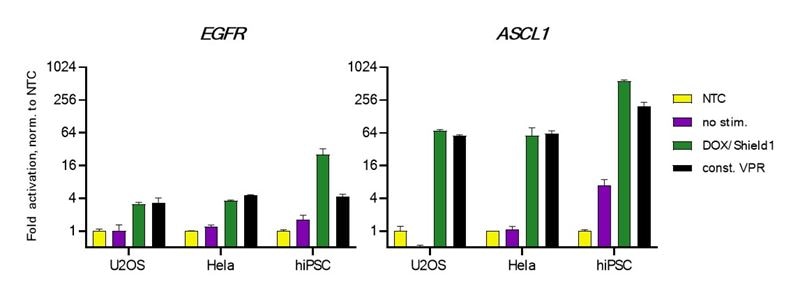
Figure 2: U2OS, Hela, and human induced pluripotent stem cells (hiPSCs) expressing either the Strict-R Inducible Lentiviral CRISPRa System or dCas9-VPR under control of the constitutive hEF1α promoter (const. VPR, in black) were transduced with CRISPRmod™ CRISPRa lentiviral sgRNA targeting EGFR or ASCL1 or a CRISPRmod CRISPRa lentiviral non-targeting control (NTC) at MOIs of 0.3. After 48 hours, cells were selected with 2.5 µg/µL puromycin for 5 to 7 days. Cells were plated in 96-well plates at 20,000 cells/well and stimulated with 0.5 µg/ mL doxycycline and 0.25 nM Shield1 for 48 hours prior to harvest. Total RNA was isolated and relative gene expression was measured using RT-qPCR. The relative expression of each gene was calculated with the ∆∆Cq method using ACTB as the housekeeping gene and normalized to an NTC. Robust target gene upregulation was observed with the Strict-R Inducible Lentiviral CRISPRa System after 48 hours of stimulation, comparable to levels achieved with the constitutive dCas9-VPR system, with minimal background target gene activation (leakiness) observed in the unstimulated cell populations.
FACS can be used to select for Strict-R Inducible Lentiviral CRISPRa positive cells with high EGFP co-expression to enrich for CRISPRa activity in Jurkat cells
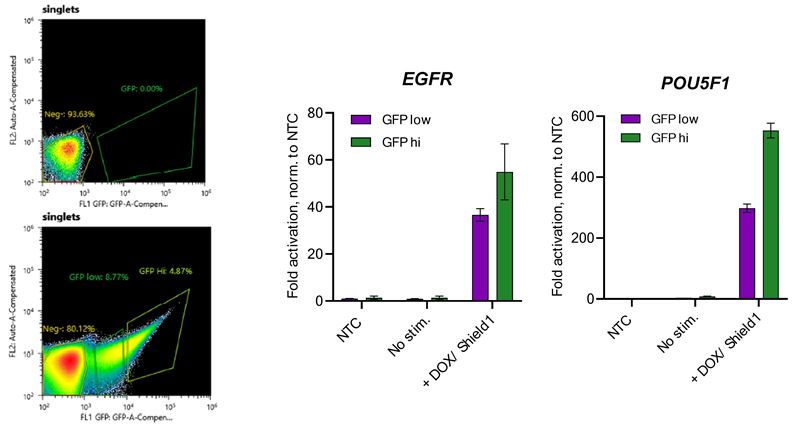
Figure 3: Jurkat cells were transduced with Strict-R Inducible Lentiviral CRISPRa EGFP particles at an MOI <0.3. Cells were expanded and then FACS was performed to sort the cells into two categories, GFP low and GFP hi (sic), based on fluorescence intensity. Following sorting, cells were replated in 6-well dishes and allowed to recover and expand. Cells were then transduced with CRISPRmod CRISPRa lentiviral sgRNA targeting EGFR or POU5F1 or a CRISPRmod CRISPRa lentiviral non-targeting control (NTC) at MOIs of 0.3. After 48 hours, cells were selected with 2.5 µg/µL puromycin for 5 days. Cells were plated in 96-well plates at 20,000 cells/well and stimulated with 0.5 µg/ mL doxycycline and 0.25 nM Shield1 for 48 hours prior to harvest. Total RNA was isolated and relative gene expression was measured using RT-qPCR. The relative expression of each gene was calculated with the ∆∆Cq method using ACTB as the housekeeping gene and normalized to an NTC. Robust target gene upregulation was observed after 48 hours of stimulation with substantially more target activation in the GFP hi populations. Importantly, minimal background target gene activation (leakiness) was detected in both GFP low and GFP hi populations of unstimulated cells indicating enrichment for high effector expression does not significantly increase background activation.
Drug-induced activation of ASCL1 leads to upregulation of downstream targets DLL1 and DLL3 in hiPSCs
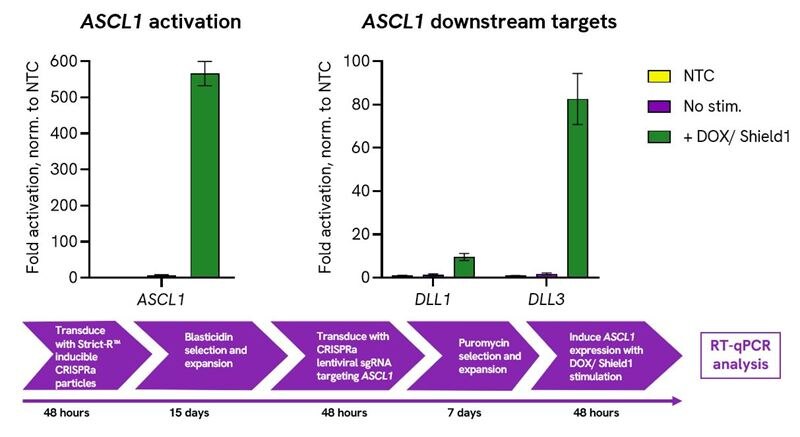
Figure 4: Human induced pluripotent stem cells (hiPSCs) expressing the Strict-R Inducible Lentiviral CRISPRa System were transduced with CRISPRmod CRISPRa lentiviral sgRNA targeting ASCL1 or a CRISPRmod CRISPRa lentiviral non-targeting control (NTC) at MOIs of 0.3. After 48 hours, cells were selected with 2.5 µg/µL puromycin for 7 days. Cells were plated in 96-well plates at 20,000 cells/well and stimulated with 0.5 µg/ mL doxycycline and 0.25 nM Shield1 for 48 hours prior to harvest. Total RNA was isolated and the relative gene expression was measured using RT-qPCR for ASCL1 and its downstream Delta gene targets DLL1 and DLL3. The relative expression of each gene was calculated with the ∆∆Cq method using ACTB as the housekeeping gene and normalized to an NTC. Activation of Delta genes by proneural transcription factors such as ASCL1 is an evolutionarily conserved step in neurogenesis that results in activation of Notch signaling and maintenance of an undifferentiated state in a subset of neural progenitors. Stimulation with doxycycline and Shield1 induced potent activation of ASCL1 which resulted in marked upregulation of both DLL3 and DLL1. Crucially, low level background activation of ASCL1 did not significantly impact DLL1 or DLL3 expression.
- Bhaya, et al., CRISPR-Cas systems in bacteria and archaea: versatile small RNAs for adaptive defense and regulation. Annu. Rev. Genet. 45, 273-297 (2011).
- M. Jinek, et al., A programmable dual-RNA-guided DNA endonuclease in adaptive bacterial immunity. Science. 337, 816-821 (2012).
- L.S. Qi, et al., Repurposing CRISPR as an RNA-guided platform for sequence-specific control of gene expression. Cell. 152, 1173-83 (2013).
- L.A.Gilbert, et al., CRISPR-mediated modular RNA-guided regulation of transcription in eukaryotes. Cell. 154, 442-51 (2013).
- A.W. Cheng, et al., Multiplexed activation of endogenous genes by CRISPR-on, an RNA-guided transcriptional activator system. Cell Res., 23, 1163-71 (2013).
- L. A. Gilbert, et al., Genome-Scale CRISPR-Mediated Control of Gene Repression and Activation. Cell. 159, 647–661 (2014).
- M. E. Tanenbaum, et al., A protein-tagging system for signal amplification in gene expression and fluorescence imaging. Cell. 159, 635–646 (2014).
- S. Konermann, et al., Genome-scale transcriptional activation by an engineered CRISPR-Cas9 complex. Nature. 517, 583–588 (2015).
- R. Loew, et al., Improved Tet-responsive promoters with minimized background expression. BMC Biotechnol. 10, 81 (2010).
- Banaszynski, Laura A et al., A rapid, reversible, and tunable method to regulate protein function in living cells using synthetic small molecules. Cell. 126, 995-1004 (2006).
- Egeler, Emily L et al., Ligand-switchable substrates for a ubiquitin-proteasome system. The Journal of Biological Chemistry. 286, 31328-36 (2011).
- M. A. Horlbeck et al., Compact and highly active next-generation libraries for CRISPR-mediated gene repression and activation. eLife. 5, e19760 (2016).
- Maynard-Smith, Lystranne A et al., A directed approach for engineering conditional protein stability using biologically silent small molecules. The Journal of Biological Chemistry. 282, 24866-72 (2007).
LentiBOOST™レンチウイルストランスダクションエンハンサーは、レンチウイルススピンフェクションの有無にかかわらず使用可能な独自処方のトランスダクション試薬です。細胞生存率を維持しながら、ウイルス導入効率を向上させることができます。患者由来の貴重な初代細胞や複雑な動物モデルの構築において特に有用であり、トランスダクション効率の向上により、各編集・導入ステップの成功率を高め、時間およびコスト削減につながります。また、LentiBOOST技術はすでに複数の臨床段階治療法の製造に使用されており、臨床応用を見据えたワークフローへの適用可能性を示しています。
LentiBOOSTはDharmacon試薬カタログから購入可能です。
LentiBOOST技術の詳細については、Revvity LentiBOOSTウェブページをご覧ください。
Supporting Data
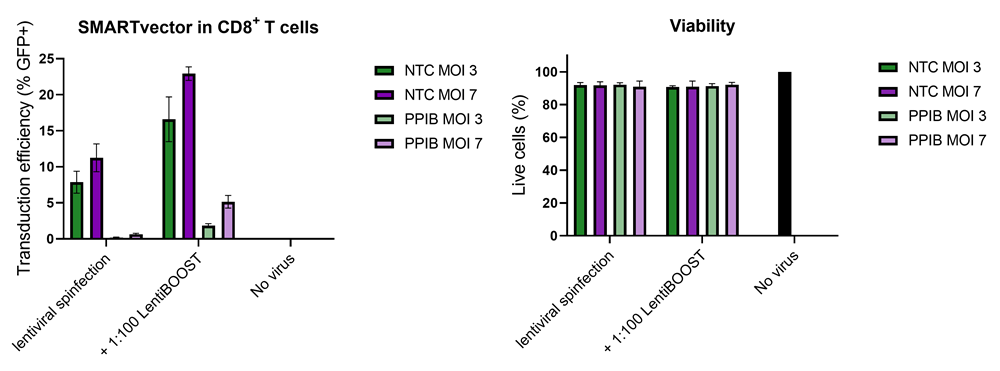
LentiBOOST™ Lentivirus Transduction Enhancerを用いたCD8+ T細胞SMARTvector™ shRNAレンチウイルスシステムのトランスダクション効率向上
100,000個のヒト初代CD8+ T細胞に、NTCまたはPPIBを標的とするSMARTvector™ mCMV tGFPレンチウイルスコントロール粒子を、30,000 TU(MOI 3、緑)または70,000 TU(MOI 7、紫)で、1:100希釈のLentiBOOSTトランスダクションエンハンサーとともに導入しました。細胞は32 °C、800 x gで1時間遠心後、4時間培養し、その後レンチウイルス粒子およびトランスダクションエンハンサーを除去しました。トランスダクション効率(生細胞中のGFP陽性率)および細胞生存率は、トランスダクション5日後にフローサイトメトリーで評価しました。LentiBOOST技術の添加により、細胞生存率に大きな影響を与えることなく、トランスダクション効率が顕著に向上しました。
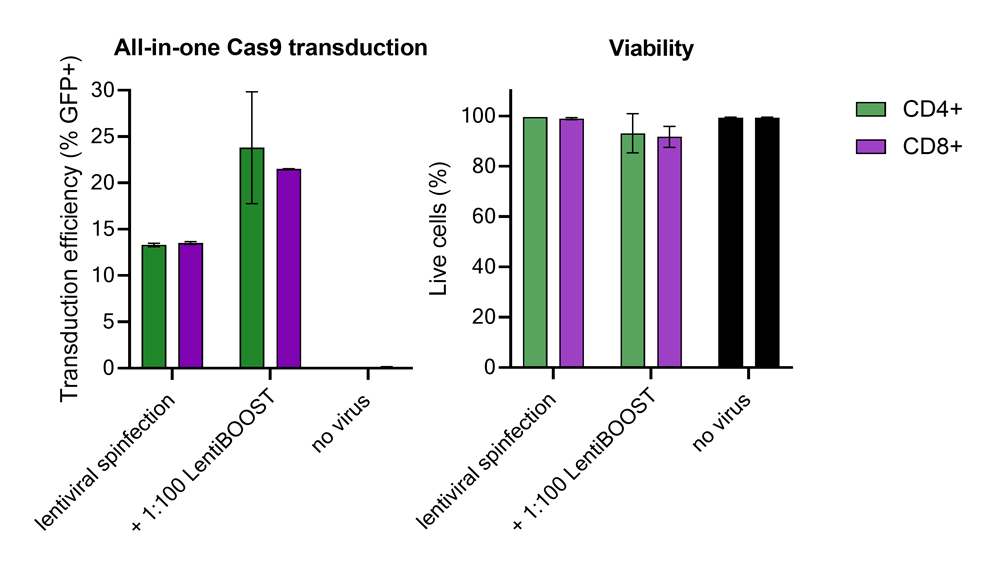
LentiBOOST™ Lentivirus Transduction Enhancerを用いたCD4+およびCD8+ T細胞Edit R™ All in one sgRNA/Cas9レンチウイルスシステムのトランスダクション効率向上
2名のドナー由来の100,000個のヒト初代CD4+およびCD8+ T細胞に、Edit R GFP DeliveryコントロールmCMVを250,000 TUで、1:100希釈のLentiBOOSTトランスダクションエンハンサーとともに導入しました。細胞は32 °C、800 x gで1時間遠心後、一晩培養し、その後レンチウイルス粒子およびトランスダクションエンハンサーを除去しました。トランスダクション効率および細胞生存率は、トランスダクション72時間後にフローサイトメトリーで評価しました。LentiBOOST技術の添加により、細胞生存率に大きな影響を与えることなく、トランスダクション効率が顕著に向上しました。
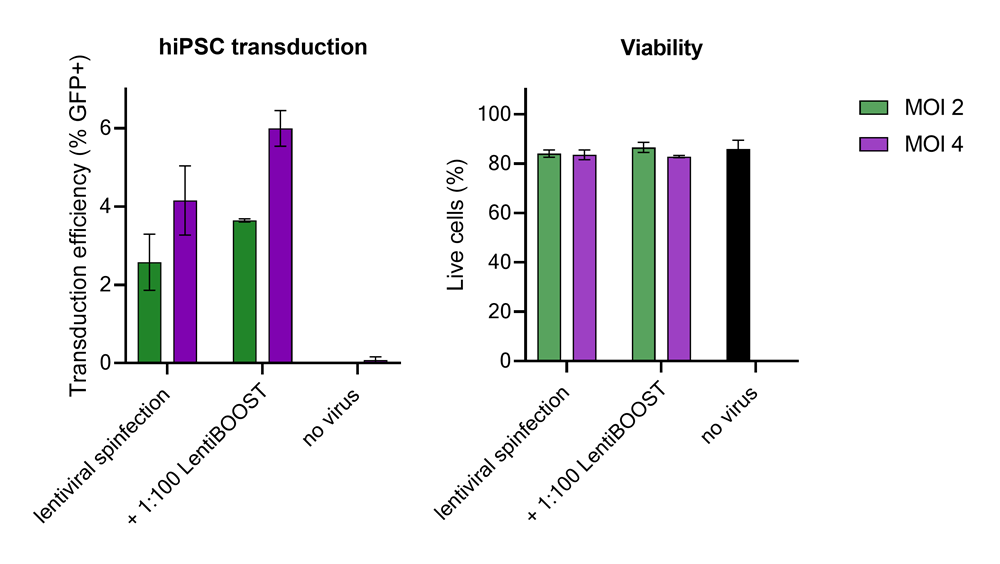
LentiBOOST™ Lentivirus Transduction Enhancerを用いたStrict R™ Inducible CRISPRaレンチウイルスシステムによるヒト人工多能性幹細胞(hiPSC)のトランスダクション効率向上

10,000個のWTC hiPSCに、Strict R™ Inducible EGFP dCas9 VPRレンチウイルス粒子を20,000 TU(MOI 2、緑)または40,000 TU(MOI 4、紫)で、1:100希釈のLentiBOOSTトランスダクションエンハンサーとともに導入しました。細胞は32 °C、800 x gで1時間遠心後、一晩培養し、その後レンチウイルス粒子およびトランスダクションエンハンサーを除去しました。トランスダクション効率および細胞生存率は、トランスダクション72時間後にフローサイトメトリーで評価しました。LentiBOOSTの添加により、細胞生存率に大きな影響を与えることなく、トランスダクション効率が顕著に向上しました。
Protocols
Safety data sheets
Related Products
ヒトおよびマウスモデルの非常に効率的な遺伝子転写活性化のためのデザイン済みCRISPRa lentiviral sgRNA
LentiBOOST transduction enhancer can increase successful viral transduction in challenging to transduce cells, or, complex cellular engineering work; while preserving cell viability and minimizing the amount of viral particles required for your experiment. LentiBOOST technology is actively used in the production of clinical stage lentivirally delivered therapies, including some approved therapies, providing a direct path to therapeutic applicability for your research studies. Tested with Dharmacon Lentiviral reagents.
レンチウイルスsgRNAコンストラクトはバイオインフォマティクスに基づいて設計され、ヒトやマウスのゲノムのどの遺伝子も標的としないことが検証されています。
遺伝子転写活性化実験の最適化と遺伝子活性化効率の確認のための検証済みのlentiviral sgRNAポジティブコントロール