





Our website has a fresh new "look"
We've updated our site with modern design and easier navigation, but you'll still find the same quality Dharmacon™ reagents and Mimix™ reference standards that you love.

Deliver two sgRNAs targeting either the same gene or different genes with a single transduction.
The Dharmacon DyadGuide™ dual-sgRNA platform is designed to efficiently deliver two sgRNAs from a single lentiviral vector using a novel bidirectional U6 promoter. This enables targeted gene modulation across CRISPRmod™ CRISPRa (activation), CRISPRmod™ CRISPRi (repression), and Edit-R™ CRISPRko (knockout). You can use DyadGuide dual-sgRNAs to:
- Target the same gene with two sgRNAs for enhanced gene activation, repression, or knockout
- Target two different genes to enable more complex experimental designs while reducing time, effort, and overall experimental risk
In addition to providing sgRNA-only formats and All-in-one formats that include the appropriate dCas9-effector or Cas9, DyadGuide is intended to help address variability in guide expression seen with other dual-sgRNA approaches—particularly strategies that rely on sequential Pol III promoters.
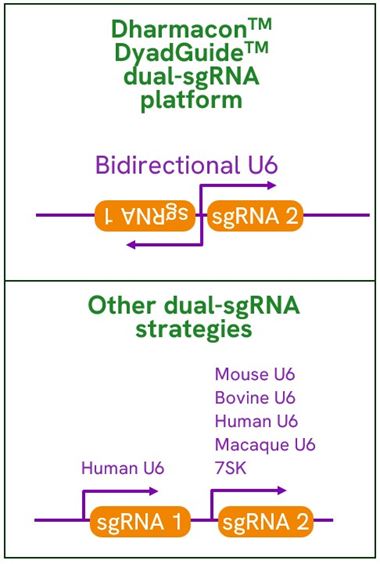
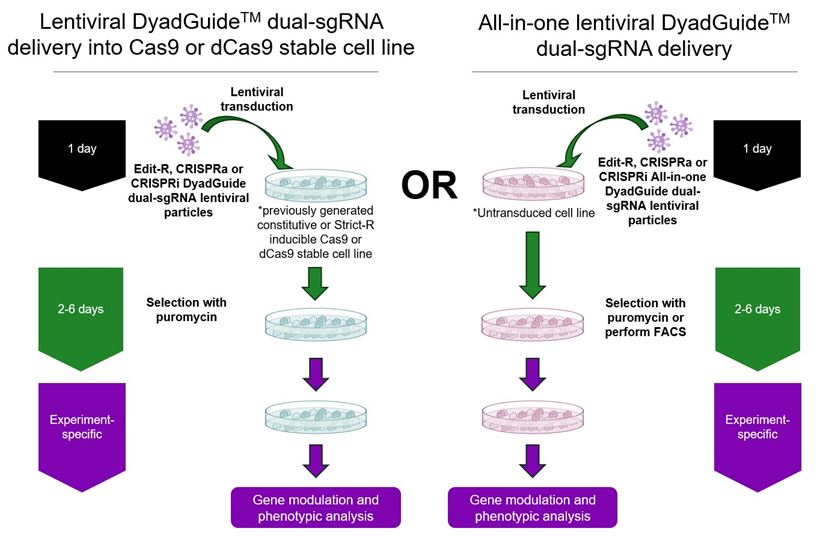
Figure1. (Left) The DyadGuide dual-sgRNA platform utilizes a bidirectional U6 promoter to drive efficient and uniform expression of both sgRNAs, overcoming limitations seen when sgRNAs are expressed by multiple sequential promoters. (Right) This platform enables a streamlined single transduction workflow for gene editing or modulating your target(s) of interest.
Order DyadGuide dual-sgRNAs
Edit-R, CRISPRa, and CRISPRi Lentiviral and All-in-one lentiviral dual-sgRNA
Deliver two sgRNAs targeting either the same or different genes a single lentiviral vector.
Lentiviral DyadGuide dual-sgRNA controls
Positive control and negative control dual-sgRNA constructs for Edit-R, CRISPRa, and CRISPRi.
All-in-one lentiviral DyadGuide dual-sgRNA controls
Positive control and negative control dual-sgRNA constructs for Edit-R, CRISPRa, and CRISPRi.
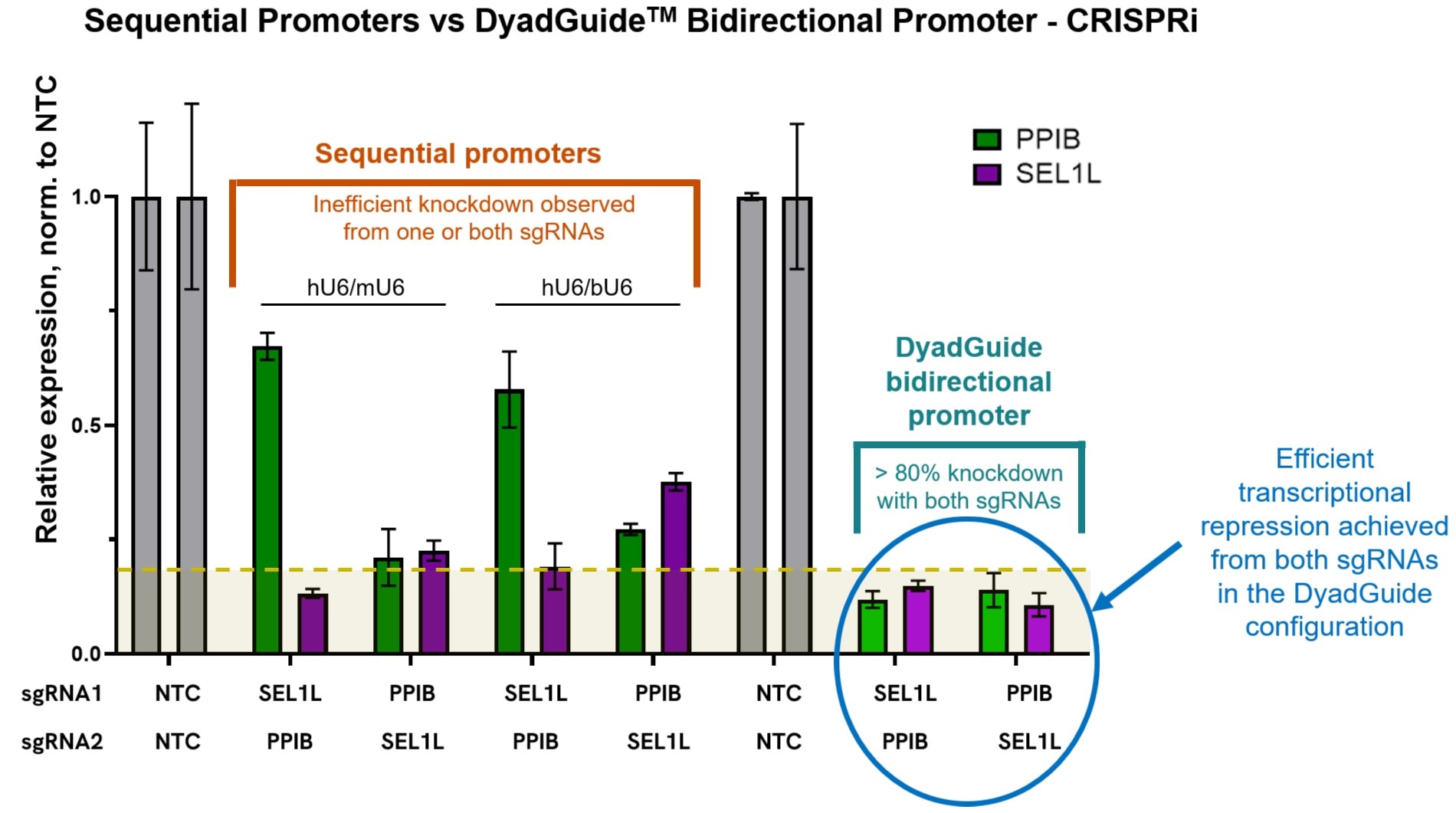
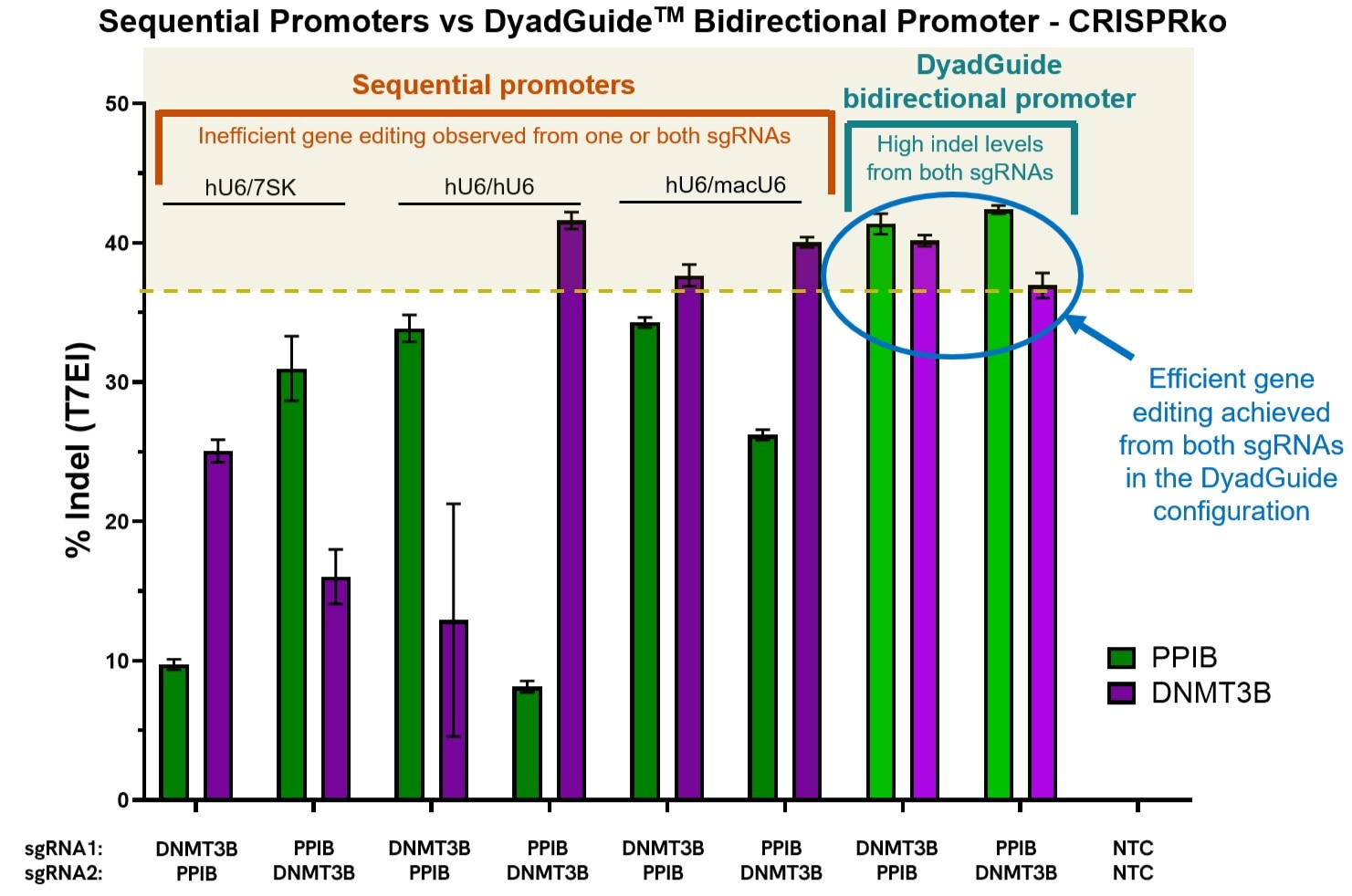
Supporting data demonstrate synergistic CRISPR activation with dual sgRNAs targeting the same gene and robust CRISPRi-mediated repression and CRISPR gene editing using the single-vector DyadGuide™ design targeting two separate genes, including outcomes that outperform sequential promoter strategies for dual-targeting applications.
|
|
| U2OS (10,000 cells/well), were plated in 96-well plates, allowed to adhere for 24 hours, and transduced with CRISPRmod CRISPRi All-in-one Lentiviral DyadGuide dual-sgRNA particles containing sgRNAs targeting both PPIB and SEL1L, All-in-one vectors containing sequential U6 promoters (combinations of Human U6 (hU6) and mouse U6 (mU6) or hU6 and bovine U6 (bU6)) driving expression of sgRNAs targeting both PPIB and SEL1L, or CRISPRi All-in-one lentiviral particles containing sgRNAs targeting SEL1L at MOIs of 0.3. CRISPRmod CRISPRi All-in-one Lentiviral DyadGuide dual-sgRNA particles containing two non-target control (NTC) sgRNAs were used as a control. 24 hours post-transduction, cells were selected with 2.5 µg/µL puromycin for 5 days. Total RNA was isolated and relative gene expression was measured using RT-qPCR. The relative expression of each gene was calculated with the ∆∆Cq method using ACTB as the housekeeping gene and normalized to an NTC. |
U2OS (10,000 cells/well), were plated in 96-well plates, allowed to adhere for 24 hours, and transduced with Edit-R All-in-one Lentiviral DyadGuide dual-sgRNA particles containing sgRNAs targeting both PPIB and DNMT3B or All-in-one vectors containing sequential U6 promoters (combinations of Human U6 (hU6) and 7SK, hU6 and hU6, or hU6 and macaque U6 (macU6)) driving expression of sgRNAs targeting both PPIB and DNMT3B, at MOIs of 0.3. Edit-R All-in-one Lentiviral DyadGuide dual-sgRNA particles containing two non-target control (NTC) sgRNAs were used as a control. 24 hours post-transduction, cells were selected with 2.5 µg/µL puromycin for 5 days. Genomic DNA was extracted for DNA mismatch detection assay with T7 Endonuclease I (T7EI) assay. Bar graph quantification of T7EI gene editing by mismatch assay was determined using the T7EI calculator. |