




Many primary cells and other biologically relevant cell models are difficult to transfect using conventional siRNA delivery methods. Transfection reagents, electroporation, and viral delivery can introduce toxicity, alter cellular responses, or require additional optimization.
Accell™ 2.0 siRNA is uniquely designed to facilitate cellular uptake without transfection reagents, viral vectors, or electroporation.
By combining self-delivering chemical modifications with updated siRNA design criteria and realignment to current transcriptome annotations, Accell 2.0 siRNA enables targeted gene silencing in primary cells and other difficult-to-transfect cell types.
Simply add Accell 2.0 siRNA to your cells using the recommended delivery conditions to achieve RNAi without the need for conventional transfection.
Key Benefits
- No transfection reagents required - eliminates reagent-induced toxicity and cellular stress
- Preserves native cell biology - maintains physiological relevance of your model system
- Simplified protocol - reduces optimization time and experimental variables
- Broad cell compatibility - effective in primary cells and other difficult-to-transfect models
Workflow
- Prepare Accell 2.0 siRNA delivery mix at recommended 1 μM concentration
- Add delivery mix directly to your cells
- Incubate for 72 hours to achieve mRNA silencing
- Observe optimal protein knockdown around 96 hours
Note: Serum proteins may inhibit delivery. Use serum-free Accell Delivery Media or ≤2.5% serum. Full-serum media can be reintroduced after 48 hours.
Application of Accell 2.0 siRNA simplifies targeted gene knockdown
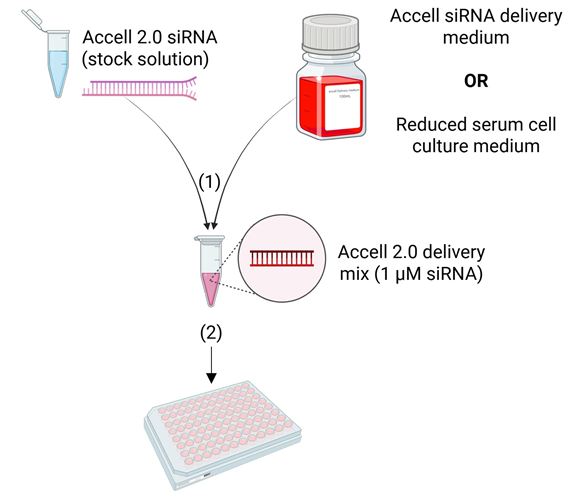
- Combine Accell 2.0 siRNA with Accell siRNA delivery media (or other reduced serum media).
- Add Accell 2.0 delivery mix directly to cells and incubate for 72 hours.
Figure created in with BioRender.com
Order products
Accell™ 2.0 siRNA
Find Accell™ 2.0 siRNA for simple, guaranteed knockdown of any human, mouse, or rat gene, now with updated design criteria and realignment to current transcriptome annotations
Accell™ 2.0 Controls
Positive and non-targeting controls for gene knockdown experiments using Accell™ 2.0 siRNA
Find predefined pathway or gene family screening libraries of Accell™ 2.0 siRNA
Helpful resources
A Novel ex vivo Application of RNAi for Neuroscience - Application Note
Demonstrates use of Accell siRNA in ex vivo culture as a means of bridging the gap between in vitro cell cultures and in vivo models for neuronal molecular pathway research
Accell siRNA - Achieving Long-term Gene Silencing - Application Note
Long-term gene knockdown is important when understanding the gene function, but lentiviral approaches are not always possible. In this document we demonstrate how to get 30 day gene down regulation by repeated application of Accell modified siRNA without affecting the viability of the cells
Gene Silencing Workflow with Accell siRNA - Application Note
Dignissim convallis aenean et tortor at risus viverra adipiscing at.
Innovative technology that enables RNAi in difficult to transfect cells - Poster
Investigations at Dharmacon have led to the development of an innovative molecule for delivery in a wide variety of cell types. These modified siRNAs have been found to effectively silence target genes in cell types that are typically difficult to transfect using standard delivery methods
| Peer-reviewed publications demonstrate effective silencing in numerous cell types | |
|---|---|
| Human Suspension Cell Lines | BDCM, IM-9, Jurkat, K662, THP-1, Jeko-1 and Mino MCL |
| Human Adherent Cell Lines | A-375, ARPE-19, CaCo-2, CG4, DLD-1, DU-145, EC52, GTM-3, MR32, LAN5, LNCaP, MIA PaCa-2, NCI/ADR-RES, OVCAR-3, OVCA-420, PGA1, PNT2, SH-SY5Y, SK-N-BE and SK-N-SH neuroblastoma, SK-BR3, SKOV3, TE15, U251, U87MG, U937 |
| Mouse Adherent Cell Lines | ES-D3, H9c2, LbT2, LNK, mouse oviduct epithelial cells, mProx24, PC-12 |
| Human Differentiated Stem Cells | Adipocytes and osteoblasts from hMSC |
| Human Primary Cells | HUVEC, HUASMC, hMSC, PBMC, astrocytes, hypothalamic neurons, T cells, NK cells, macrophages, immortalized B cells, esthesioneuroblastoma cells, hepatocytes, bronchial smooth muscle cells |
| Mouse and Rat Primary Cells | Cortical neurons, hippocampal neurons, striatal neurons, Naïve CD4+ T cells, LN T cells, D1 T cells, RAW264.7 macrophages, hepatocytes, neonatal ventricular cardiomyocytes, fibroblasts derived from genetically-modified mice, bone marrow-derived DC, NOD CD4+ CD25- splenic cells, NOD BMMs, VSMCs, somatolactotroph GH3, McArdle 7777 cells (hepatoma cell line), osteoclast precursors, calvarial (cranial) organ, pituitary cell types derived from primary tumors |
| In vivo Animal Applications | Please contact Scientific Support for guidance |
Application of Accell 2.0 siRNA simplifies targeted gene knockdown
- Combine Accell 2.0 siRNA with Accell siRNA delivery media (or other reduced serum media).
- Add Accell 2.0 delivery mix directly to cells and incubate for 72 hours.
Figure created in with BioRender.com
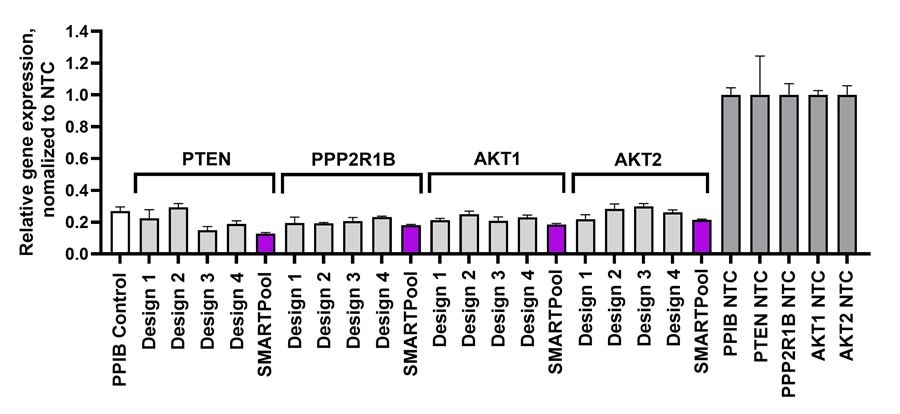
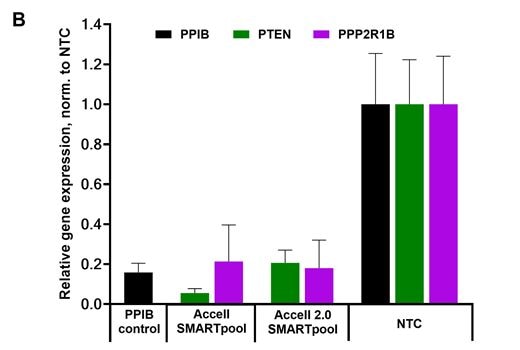
Accell 2.0 siRNA maintains performance of gene target knockdown set by Accell siRNA in neurons derived from induced WTC-11 iPSC cells
|
|
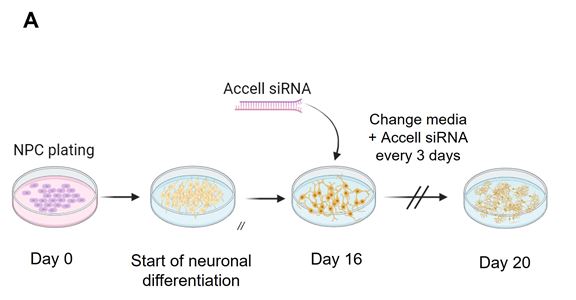
Characterization of target mRNA knockdown by Accell and Accell 2.0 siRNAs in cultured neurons. Data are shown relative to neurons treated with non-targeting control (NTC) siRNA. Experimental schematic (A) and relative gene expression in WTC-11-derived neurons (B). Neurons derived from WTC-11 iPSCs were cultured in differentiation medium for 14 days, with daily medium replenishment. On day 14, 50 µL of medium was removed and replaced with 50 µL fresh medium containing 2 µM Accell or Accell 2.0 pooled siRNA designs (4 siRNA designs at 0.5 µM each) or 2 µM Accell PPIB control (Cat# D-001920-01), resulting in a final siRNA concentration of 1 µM in all conditions. An identical concentration of Accell Non-targeting Control siRNA #1 (D-001910-01) was used for each target NTC condition. siRNA mixtures were replenished by half-medium change on differentiation days 16 and 18, for a total of three siRNA additions. Total RNA was extracted on differentiation day 20 for downstream processing. Figure A is created with BioRender.com.
Performance of target mRNA knockdown in matrix-free 3D spheroids is maintained with Accell 2.0 siRNA
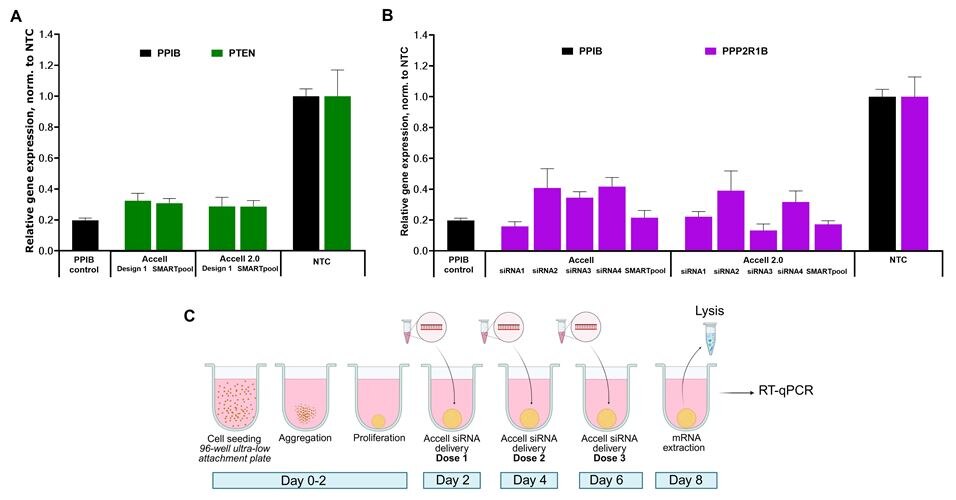
Characterization of Accell and Accell 2.0 siRNA-mediated mRNA knockdown in ECM-free HCT-116 spheroids. Control, PTEN (A), and PPP2R1B (B) mRNA expression were quantified in HCT-116 spheroids after 144 hours of siRNA treatment. (C) Dosing timeline for Accell 2.0 siRNA delivery. Spheroids were generated by seeding 3,000 HCT-116 cells into ECM-free, 96-well ultralow attachment round-bottom plates in HCT-116 medium (McCoy’s 5A medium supplemented with 10% FBS and 2 mM L-glutamine). After two days, 50% of the medium was removed and replaced with 2 µM Accell or Accell 2.0 single or pooled siRNA designs (4 siRNAs at 0.5 µM each) for a final concentration of 1 µM siRNA. Matching concentrations of Accell Non-targeting Control siRNA #1 (D-001910-01) or Accell PPIB control siRNA (D-001920-01) were added on the same schedule. After three rounds of siRNA replenishment, spheroids were lysed, total nucleic acid was collected, and RT-qPCR was used to measure target mRNA abundance. Data are shown relative to target expression in spheroids treated with non-targeting control siRNA. Figure C is created with BioRender.com.
Target protein knockdown in matrix-free 3D spheroids using Accell 2.0 siRNA
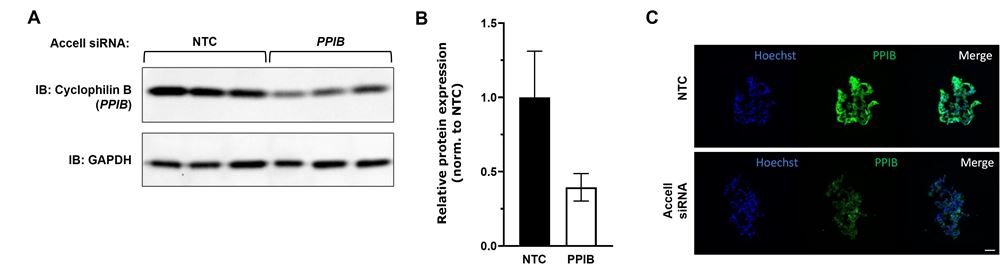
Characterization of Accell siRNA-mediated cyclophilin B (PPIB) target protein knockdown in ECM-free HCT-116 spheroids. Data are presented relative to expression in spheroids treated with non-targeting control (NTC) siRNA. (A) Western blot and (B) quantification of Cyclophilin B protein expression in HCT-116 spheroids determined from (A) after 144-h siRNA treatment. Each lane is representative of an independent pool of spheroids (N=3). (C) Immunocytochemistry images of serially sectioned HCT-116 spheroids after 144-h siRNA treatment with an Accell PPIB Control Pool or NTC Pool. Spheroids were then collected, fixed in 2% paraformaldehyde, embedded in optimal cutting (O.C.T.) temperature compound, flash frozen, and serially sectioned. Material was incubated with 1:200 dilution of primary antibody against PPIB (anti-cyclophilin B, Abcam ab16045) and secondary incubation with 1:500 dilution of Alexa 488-conjugated Goat-anti-rabbit antibody (Invitrogen A11034) and 1:1000 dilution of Hoechst 33342 (Molecular Probes H-3570). Scale bar = 200 µM.
Accell control siRNA demonstrates effective uptake and silencing in organotypic brain slices
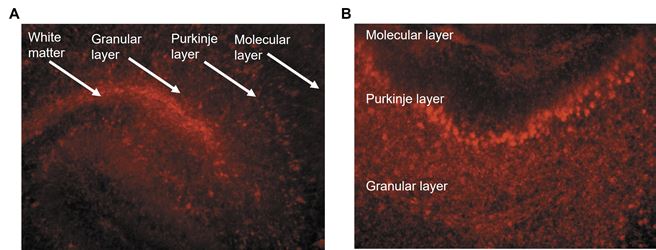
Accell siRNA shows increased uptake with extended incubation. 250 µM cerebellar sections were prepared, cultured, and incubated for 3 hours (A) and 72 hours (B) with Accell Red Non-targeting control (NTC) siRNA (Cat# D-001960-01-05) before inspection by microscopy.
Robust gene target knockdown in primary lung fibroblasts using Accell 2.0 siRNA