Complex genome engineering with the Pin-point base editing system, even in sensitive cell types
An application note demonstrating complex genome engineering with the Pin-point base editing system.

Accelerate therapeutic development with Revvity's Pin-point™ base editing reagents.
The modular Pin-point base editing platform combines engineered guide RNA, nickase Cas9, and a deaminase enzyme to deliver precise single-nucleotide edits in sensitive cell types, including T cells and iPSCs, without double-strand breaks. The system's modularity allows customizable configurations for both adenine (ABE) and cytosine (CBE) base editing.
With validated performance in T cells, iPSCs, and HSPCs, the Pin-point base editing platform delivers improved safety over standard CRISPR-Cas9 with multiplex editing capabilities.
Pin-point base editing reagents are available for research use only and are not for diagnostic use or direct administration into humans or animals. The Pin-point™ base editing platform technology is available for clinical or diagnostic study and commercialization under a commercial license from Revvity.


Pin-point base editing mRNA
Custom Pin-point synthetic sgRNAs
Pin-point synthetic sgRNA validated controls
Pin-point synthetic sgRNA non-targeting controls
Precise single-nucleotide editing without double-strand breaks
Validated performance and verified reagents for use in T cells, iPSCs, and HSPCs
Improved safety over standard CRISPR-Cas9
Modular system for optimized research
Multiplex editing across several targets
Versatile technology for targeted editing
Revvity's Pin-point base editing technology is a flexible, three-part system that uses an engineered guide RNA to bring all the pieces of the editing machinery together on-target in the genome.
A nickase Cas9 (nCas9) is guided to a specific DNA sequence by a modified guide RNA (gRNA). This gRNA includes an aptamer "handle", which acts like a docking site to recruit the editing enzyme (such as an ABE or CBE deaminase) via a matching binding protein.
By placing the recruitment function on the gRNA rather than permanently attaching the enzyme to Cas9, the system allows for greater flexibility. This means you can mix and match components, fine-tune activity, and even recruit multiple functions at once for more advanced genome engineering applications such as CAR-T cells generation.
System components
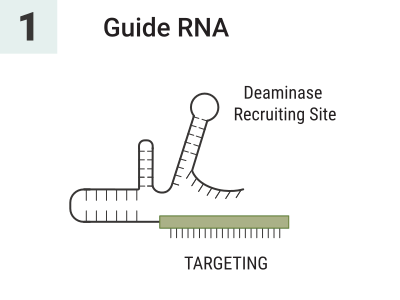

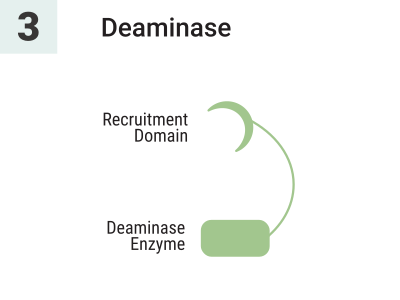
The modular Pin-point base editing system facilitates highly efficient and precise nucleotide conversion with the potential for multiplex gene editing capabilities. The modularity of the system means we can offer a customizable, off-the-shelf system for base editing.
Reagents for the Pin-point base editing platform are now available in both Adenine base editing (ABE) and Cytosine base editing (CBE) configurations. View the product pages for more details.
To learn more about potential licensing and service options please visit revvity.com.