
CRISPR activation
Up-regulate gene expression, without cutting the DNA
CRISPR activation (CRISPRa) allows researchers to up-regulate specific gene function by activating transcription, without editing the DNA.
Our CRISPRa reagents provide a straightforward, efficient set of tools to study a gene's function.
Visit our CRISPRa applications page to learn more about key benefits to using CRISPRa for gene over-expression.


Reagents
CRISPRa guide RNA
-
Synthetic sgRNA
Predesigned synthetic guide RNA for over-expression of human and mouse genes using CRISPR activation. -
Synthetic crRNA
Co-transfect with Edit-R tracrRNA for a DNA-free CRISPR activation workflow. -
Lentiviral sgRNA
An ideal delivery method for CRISPR activation in difficult-to-transfect cells. -
All-in-one lentiviral sgRNA
Single reagent – dCas9-VPR + sgRNA in one vector for easy gene to cell delivery. -
Dyadguide lentiviral and All-in-one dual-sgRNA
Deliver two sgRNAs targeting either the same gene or two different genes in a single lentiviral vector.
CRISPRa dCas9-VPR
-
dCas9-VPR mRNA
Co-transfect or electroporate with synthetic sgRNA for transient CRISPRa in lentiviral-free workflows. -
dCas9-VPR lentiviral particles
Create a stable dCas9-VPR constitutive expressing cell line, ready for CRISPRa studies. -
Strict-R inducible dCas9-VPR lentiviral system
Strict-R is a unique dual-controlled inducible system for tightly controlled gene activation in diverse cell types. -
dCas9-VPR stable cell lines
"CRISPRa-ready" cell lines - simply introduce guide RNA for targeted gene activation.
Controls, additional reagents, and libraries
-
CRISPRa controls
Essential controls for successful CRISPRa experiments. -
Transfection and transduction reagents
 DharmaFECT transfection reagents, lentiviral packaging kits, and LentiBOOST transduction enhancer.
 -
CRISPRa screening libraries
 Investigate whole genome or gene families and biological pathways with our broad suite of custom and predefined synthetic or lentiviral CRISPRa libraries.
Key benefits of CRISPR activation:
-
Turns genes on using programmable targeting - dCas9-based CRISPR systems can activate specific endogenous genes when guided to promoter/enhancer regions
-
Higher precision than conventional overexpression approaches - can modulate native gene regulation rather than relying on strong transgenes
-
Scalable for functional genomics - useful for pooled and arrayed CRISPR activation screens to systematically identify genes or pathways that drive phenotypes
-
More physiologically relevant gene expression - can better reflect endogenous regulatory context compared with artificial overexpression
CRISPRa reagent selection
There are many options and considerations for CRISPRa experimental conditions. Generally, users achieve the most robust activation when working with a stable population of dCas9-VPR expressing cells. However, many formats of transient and lentiviral delivery exist.
| dCas9-VPR source | Guide RNA format | Delivery method | Recommendations for use & benefits |
|---|---|---|---|
|
CRISPRa dCas9-VPR stable cells or CRISPRa dCas9-VPR lentiviral particle transduction |
CRISPRa synthetic sgRNA | Transfection or electroporation |
|
| CRISPRa synthetic crRNA + tracrRNA | |||
| CRISPRa lentiviral sgRNA particles | Transduction |
|
|
| CRISPRa dCas9-VPR mRNA | CRISPRa synthetic sgRNA | Co-transfection or electroporation |
|
| CRISPRa synthetic crRNA + tracrRNA | |||
| CRISPRa all-in-one dCas9-VPR + sgRNA | Transduction |
|
|
| Strict-R inducible lentiviral dCas9-VPR CRISPRa | Transduction |
|
|
| CRISPRa lentiviral and All-in-one lentiviral dual-sgRNA | Transduction |
|
|
As you explore CRISPR-mediated gene activation, consider whether the NEXTFLEX™ Rapid Directional RNA Kit 2.0 could complement your gene modulation analysis through additional transcriptome profiling.
CRISPRa workflows
CRISPRa workflow diagram with stable dCas9-VPR expression
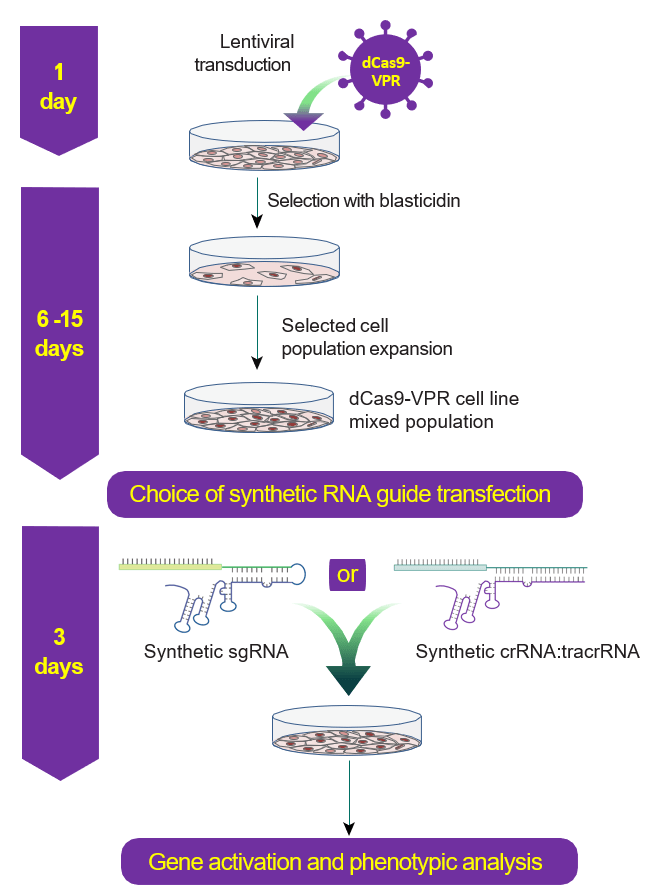
CRISPR activation workflow with Lentiviral dCas9-VPR and synthetic crRNA:tracrRNA (right side) or synthetic sgRNA (left side).

CRISPR activation workflow where either CRISPRa All-in-one lentiviral reagents or CRISPRa lentiviral sgRNA and dCas9-VPR lentiviral reagents can be transduced for activation in hard to transfect cell types.
Featured resources
Carousel items
-

Watch our "cDNA vs. CRISPRa" video
Which is better for your overexpression experiment? We’ll give some tips to help you choose. -

Watch our "What is inducible vs constitutive gene expression?" video
Gene expression using lentiviral vectors is either inducible or constitutive. Explore what this means using products from our CRISPRa portfolio as examples.
-

Read about multigene targeting with CRISPRa in T cells
Efficient multigene targeting in primary T cells with CRISPRa, CRISPRi mRNA, and synthetic guide RNAs Application Note.