CRISPR Interference
Repress gene expression without cutting the DNA
CRISPR interference (CRISPRi) allows precise, reversible down-regulation of specific gene function by blocking transcription, without permanently editing the genome. Unlike traditional CRISPR-Cas9 knockout approaches that introduce double-strand breaks, CRISPRi uses a catalytically inactive Cas9 (dCas9) fused to transcriptional repressor domains to sterically block RNA polymerase and silence target genes at the transcriptional level.
Our CRISPRi reagents provide a straightforward, efficient toolkit for studying gene function, validating therapeutic targets, and dissecting complex biological pathways. Featuring our proprietary SALL1-SDS3 repressor system, these reagents deliver robust, tunable knockdown with minimal off-target effects, ideal for applications requiring reversible gene silencing, dose-dependent repression, or multiplexed perturbation screens.
CRISPRi is particularly valuable for essential genes, non-coding RNAs, and regulatory elements where complete knockout would be lethal or uninformative. Visit our CRISPRi applications page to explore how this cutting-edge technology can accelerate your research.


Reagents
CRISPRi guide RNA
-
Synthetic sgRNA
The most rapid CRISPRi system, with repression within 24 hours post-transfection. -
Lentiviral sgRNA
An ideal delivery method for CRISPRi in difficult-to-transfect cells, or for longer term repression. -
All-in-one lentiviral sgRNA
Single reagent – dCas9-SALL1-SDS3 + sgRNA in one vector for easy gene to cell delivery. -
Dyadguide lentiviral and All-in-one dual-sgRNA
Deliver two sgRNAs targeting either the same gene or two different genes in a single lentiviral vector. -
Custom guide RNA tool
Order custom guide RNA for CRISPRi
CRISPRi dCas9-SALL1-SDS3
-
dCas9-SALL1-SDS3 mRNA
Co-transfect or electroporate with synthetic sgRNA for transient CRISPRi in lentiviral-free workflows. -
dCas9-SALL1-SDS3 lentiviral particles
Create a stable dCas9-SALL1-SDS3 constitutive expressing cell line, ready for CRISPRi studies. -
Strict-R inducible dCas9-SALL1-SDS3 lentiviral system
Strict-R is a unique dual-controlled inducible system for dual controlled gene repression in diverse cell types.
Controls, additional reagents, and libraries
-
CRISPRi controls
Essential controls for successful CRISPRi experiments. -
Transfection and transduction reagents
 DharmaFECT™ transfection and transduction reagents as well as LentiBOOST™ transduction enhancer.
 -
CRISPRi screening libraries
 Investigate whole genome or gene families and biological pathways with our broad suite of custom and predefined synthetic or lentiviral CRISPRi libraries.
CRISPR interference (CRISPRi) is a robust method for specific gene knockdown.
CRISPRi benefits
-
CRISPR specificity
PAM-anchored targeting system
-
Gentle knockdown
Knock genes down, not out
-
Extended time course
Longer repression duration compared to siRNA
-
Down-regulation
Within the gene's native context
Ideal applications
-
Loss-of-function
Study gene function in biologically relevant knockdown models
-
Multiplexing
Well-suited for simultaneous knockdown of multiple genes
-
Orthogonal validation
Use in parallel with CRISPRko and/or RNAi for robust data
CRISPRi reagent selection
There are many options and considerations for CRISPRi experimental conditions. For extended timepoint assays (more than 120 hours), we recommend lentiviral sgRNA formats. For short-term assays, synthetic sgRNA typically provides more robust gene repression.
| CRISPRi dCas9-SALL1-SDS3 source | Guide RNA format | Delivery method | Benefits & Recommended uses |
|---|---|---|---|
|
CRISPRi dCas9-SALL1-SDS3 lentiviral particle |
CRISPRi synthetic sgRNA | Transfection or electroporation |
|
| CRISPRi lentiviral sgRNA | Transduction |
|
|
| CRISPRi dCas9-SALL1-SDS3 mRNA | CRISPRi synthetic sgRNA | Co-transfection or electroporation |
|
| Strict-R inducible CRISPRi lentiviral system | CRISPRi lentiviral sgRNA | Transduction |
|
| CRISPRi all-in-one dCas9-SALL1-SDS3 + sgRNA | Transduction |
|
|
| CRISPRi lentiviral and All-in-one lentiviral dual-sgRNA | Transduction |
|
|
What is CRISPR interference | short video
Learn more about the Dharmacon CRISPRi system
Visit our CRISPRi applications page for more details on our novel dCas9-SALL1-SDS3 repressor construct, guide RNA design recommendations, proof-of-concept experiments and more.
Application with CRISPRi mRNA and synthetic sgRNA
See our application note on efficient multigene targeting in primary T cells with CRISPRa, CRISPRi mRNA, and synthetic guide RNAs, demonstrating the utility and feasibility of targeting multiple genes simultaneously with CRISPRi in primary T cells.
CRISPRi workflows
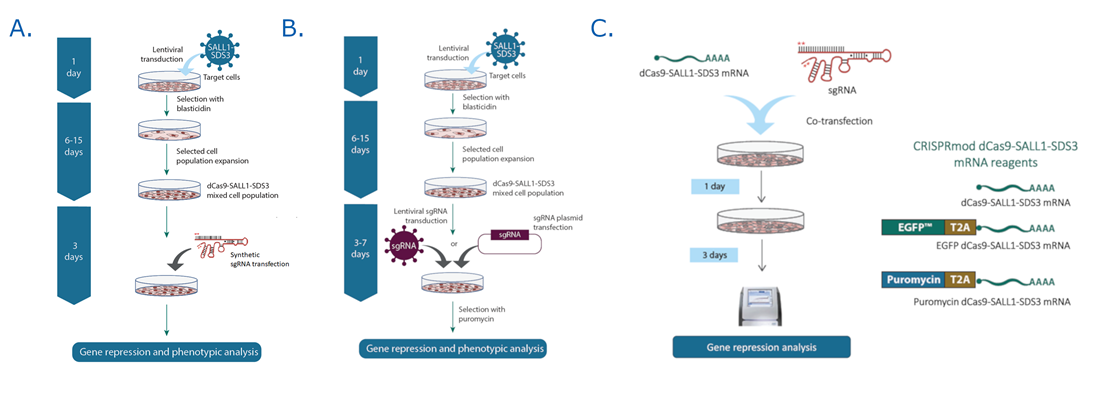
We offer multiple workflow options when using CRISPRi for transcriptional repression. See figure parts A, B, and C below. A and B start with transduction of dCas9-SALL1-SDS3 lentiviral particles to generate CRISPRi-ready, stable dCas9-SALL1-SDS3 expressing cells. Then sgRNAs are introduced to the stable line either as synthetic (figure part A) or lentiviral (figure part B) sgRNA to knockdown your target gene(s). For lentiviral delivery, the sgRNA and dCas9-SALL1-SDS3 can also be delivered via a single transduction in an All-in-one lentiviral format. These options are ideal for screening, extended time point assays or when working with difficult-to-transfect cell types.
Alternatively, one can (figure part C) co-transfect or electroporate dCas9-SALL1-SDS3 mRNA with synthetic sgRNA, and then enrich cell populations using fluorescence or puromycin resistance options. This system is best suited for rapid, transient gene repression studies.