





CRISPR Controls
CRISPR control reagents no matter your experiment.
Ensure your system is optimized with controls for CRISPR knockout, CRISPR interference, and CRISPR activation experiments. CRISPR systems require two components: a targeted guide RNA and a Cas9 component (nuclease for knockout or deactivated nuclease for interference/activation) to be delivered to the cell for effective gene perturbation. Many experimental considerations, including insufficient amounts of either component, will result in inefficient knockout/interference/activation of the target gene, so proper controls should be used for the best chances of success.

Reagents
Synthetic CRISPR knockout controls
-
Synthetic sgRNA positive controls
Species-specific sgRNAs targeting well- characterized genes as well as lethal sgRNAs designed to induce cell death. -
Synthetic sgRNA negative controls
Non-targeting control sgRNAs and safe harbor cutting control sgRNAs. -
Synthetic sgRNA validated for T-cell receptor targets
Validated Edit-R sgRNAs targeting T cell receptor genes: TRAC, TRDC, and TRBC. -
Synthetic crRNA positive controls
Species-specific crRNAs targeting well- characterized genes as well as lethal crRNAs designed to induce cell death. -
Synthetic crRNA negative controls
Non-targeting control crRNAs and safe harbor cutting control crRNAs. -
Synthetic crRNA validated for T-cell receptor targets
Validated Edit-R crRNAs targeting T cell receptor genes: TRAC, TRDC, and TRBC.
Lentiviral CRISPR knockout controls
-
Lentiviral sgRNA positive controls
Species-specific sgRNAs targeting well- characterized genes. -
Lentiviral sgRNA negative controls
Non-targeting control sgRNAs and safe harbor cutting control sgRNAs. -
All-in-one lentiviral sgRNA positive controls
Species-specific All-in-one sgRNAs targeting well-characterized genes. -
All-in-one lentiviral sgRNA negative controls
Non-targeting control All-in-one sgRNAs and safe harbor cutting control All-in- one sgRNAs. -
Lentiviral DyadGuide dual-sgRNA controls
Positive control and negative controls for DyadGuide dual-sgRNA constructs. -
All-in-one lentiviral DyadGuide dual-sgRNA controls
Positive control and negative controls for All-in-one DyadGuide dual-sgRNA constructs.
Synthetic and Lentiviral CRISPR interference controls
-
Synthetic sgRNA positive controls
Target well-characterized genes to determine the effectiveness of your experimental conditions for maximum repression. -
Synthetic sgRNA non-targeting controls
Evaluate baseline cellular responses to CRISPRi components in the absence of gene target-specific sgRNA.
-
Lentiviral sgRNA positive controls
Target well-characterized genes to determine the effectiveness of your experimental conditions for maximum repression. -
Lentiviral sgRNA non-targeting controls
Evaluate baseline cellular responses to CRISPRi components in the absence of target-specific sgRNA. -
All-in-one lentiviral positive controls
Target well-characterized genes to determine the effectiveness of your experimental conditions for maximum repression. -
All-in-one lentiviral non-targeting controls
Evaluate baseline cellular responses to CRISPRi components in the absence of gene target-specific sgRNA. -
Lentiviral DyadGuide dual-sgRNA controls
Positive control and negative controls for DyadGuide dual-sgRNA constructs. -
All-in-one lentiviral DyadGuide dual-sgRNA controls
Positive control and negative controls for All-in-one DyadGuide dual-sgRNA constructs.
Synthetic and Lentiviral CRISPR activation controls
-
Synthetic sgRNA positive controls
Pooled or individual sgRNA controls for assessment of optimal experimental conditions for gene activation. -
Synthetic sgRNA non-targeting controls
Evaluate baseline cellular responses to CRISPRa components in the absence of gene target-specific sgRNA. -
Synthetic crRNA positive controls
Pooled or individual crRNA controls for assessment of optimal experimental conditions for gene activation. -
Synthetic crRNA non-targeting controls
Evaluate baseline cellular responses to CRISPRa components in the absence of gene target-specific crRNA. -
Lentiviral sgRNA positive controls
Target well-characterized genes to determine the effectiveness of your experimental conditions for maximum activation. -
Lentiviral sgRNA non-targeting controls
Evaluate baseline cellular responses to CRISPRa components in the absence of target-specific sgRNA -
All-in-one lentiviral sgRNA positive controls
Target well-characterized genes to determine the effectiveness of your experimental conditions for maximum activation. -
All-in-one lentiviral sgRNA non-targeting controls
Evaluate baseline cellular responses to CRISPRa components in the absence of target-specific sgRNA. -
Lentiviral DyadGuide dual-sgRNA controls
Positive control and negative controls for DyadGuide dual-sgRNA constructs. -
All-in-one lentiviral DyadGuide dual-sgRNA controls
Positive control and negative controls for All-in-one DyadGuide dual-sgRNA constructs.
Controls are important for optimizing experimental conditions, such as:
-
Optimizing synthetic guide RNA transfection conditions
-
Ensuring reagents were effectively delivered across conditions
-
Providing phenotypic confirmation of delivery and/or editing
-
Determining the optimal promoter for driving lentiviral Cas9 and dCas9 based expression
-
Identifying optimal co-transfection conditions with Cas9 and dCas9 based mRNA
-
Ensuring experimental consistency and controlling for any possible background effects
CRISPR –Cas9 gene editing (knockout) controls
Use of a species-specific validated positive control with our DNA mismatch detection primers in a mismatch assay post-editing will verify the suitability of your experimental conditions for efficient CRISPR-Cas9 gene editing, and serve as an indicator of optimal transfection conditions in ongoing experiments.
Our panel of negative Non-targeting and cutting controls permits assessment of potential non-specific effects, and lets you choose the optimal negative control for your cell type and your assay.
DNA mismatch detection assays such as T7EI or TIDE, using our detection primers, are a relatively fast and high-throughput method for assessing gene knockout results in clonal or mixed cell populations.
Effective gene editing of PPIB in human and mouse cells
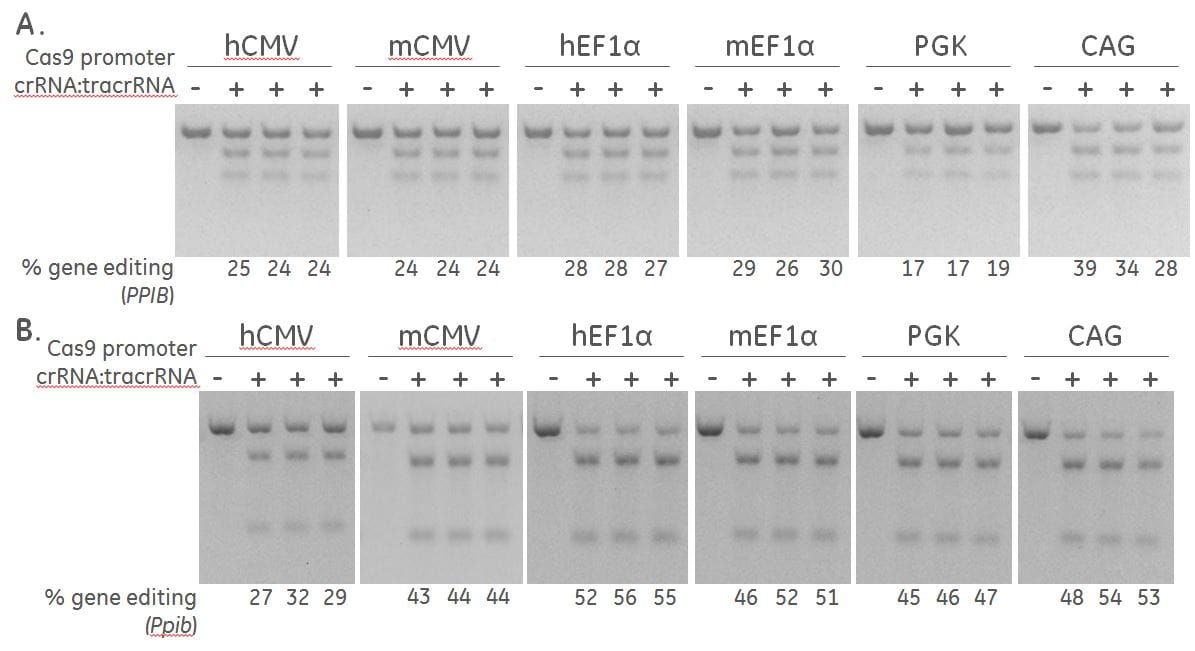
Positive control crRNA and Detection Primers targeting PPIB are used to determine the optimal promoter for driving expression of Cas9 nuclease. A human recombinant U2OS ubiquitin-EGFP proteasome cell line (Ubi[G76V]-EGFP) (A) and a mouse fibroblast (NIH/3T3) (B), were stably transduced with lentiviral particles containing Cas9 and a blasticidin resistance gene driven by the indicated promoters. A population of cells with stably integrated Cas9-blastR was selected with blasticidin for a minimum of 10 days before transfections. Cells were transfected with 50 nM synthetic crRNA:tracrRNA targeting Human PPIB / mouse Ppib using DharmaFECT 1 and DharmaFECT 3 Transfection reagent, respectively. After 72 hours, the relative frequency of gene editing was calculated based on a DNA mismatch detection assay using T7EI on genomic DNA extracted from the transfected cells.
CRISPRi controls for loss-of-function experiments
To establish optimal experimental conditions and ensure ongoing successful gene repression, it is recommended to use a validated CRISPRi positive control for a characterized gene target. The CRISPRi positive controls target SEL1L or PPIB genes.
Non-targeting (negative) controls are guide RNAs with no complementary target in the annotated human genome, so the baseline expression of any given gene should not be altered. mRNA and protein levels may change over time in CRISPRmod experiments; this should be taken into consideration when detecting expression levels. Use qPCR and Western blotting to determine changes in mRNA and protein levels compared to untreated and non-targeting controls to observe gene modulation effects.
Robust gene knockdown with CRISPRi synthetic sgRNA positive controls
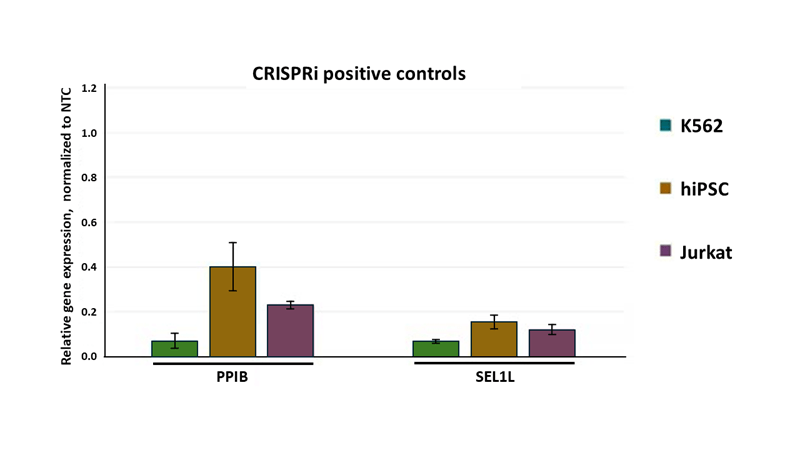
K562 and Jurkat cells were nucleofected with dCas9-KRAB or dCas9-SALL1-SDS3 mRNA (2 µg), and pooled CRISPRi synthetic sgRNAs (5 µM) targeting PPIB and SEL1L via a Lonza 96-well Shuttle system. WTC-11 hiPS cells were nucleofected with dCas9-KRAB or dCas9-SALL1-SDS3 mRNA (1 µg) and pooled CRISPRi synthetic sgRNA (3 µM) targeting PPPIB or SEL1L via a Lonza 96-well Shuttle system. Cells were harvested 72 hours post-nucleofection. Total RNA was isolated, and relative gene expression was measured using RT-qPCR. The relative gene expression for each target gene was calculated with the ∆∆Cq method using GAPDH as the housekeeping gene and normalized to a non-targeting control (NTC).
CRISPRa controls for gene activation
To establish optimal experimental conditions and ensure ongoing successful activation, it is recommended to use a species-specific CRISPRa positive control for a characterized gene target. The CRISPRa validated positive controls target human or mouse Titin (TTN/Ttn) or POU class 5 homeobox 1 (POU5F1/Pou5f1) genes.
Efficient transcriptional gene activation with CRISPRa synthetic sgRNAin dCas9-VPR stable cells
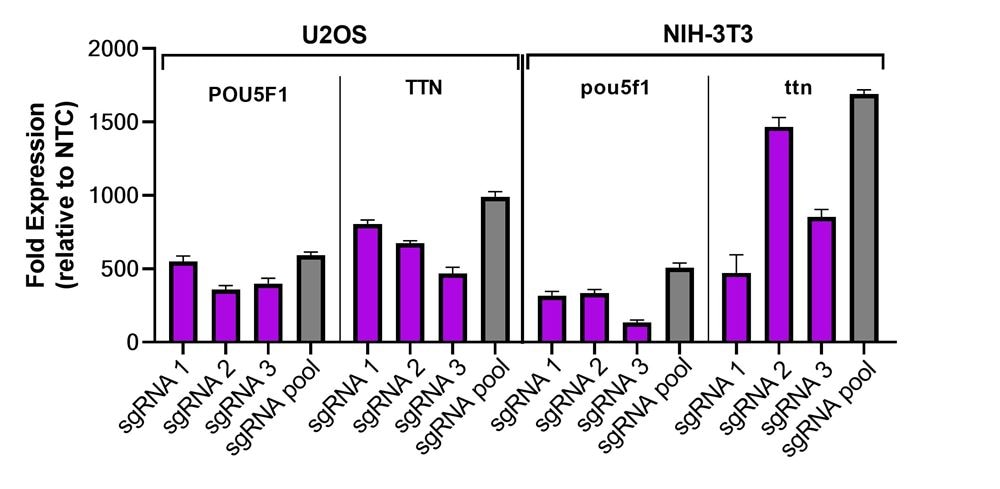
Human U2OS or mouse NIH-3T3 cells stably expressing integrated CRISPRa dCas9-VPR (driven by hEF1a promoter in human and mCMV promoter in mouse cells) were plated at 10,000 cells/well and transfected using DharmaFECT 1 Transfection Reagent (0.2 uL/well) with 25 nM individual or pooled CRISPRa synthetic single guide RNA (sgRNA) targeting either human (TTN or POU5F1) mouse (pou5f1 or ttn) gene targets. Cells were harvested at 72 hours post-transfection and gene expression was assessed using RT-qPCR. Relative fold transcriptional activation for each gene was calculated with the Cq method using beta-actin as the housekeeping gene and normalized to an experiment using non-targeting control sgRNA.
Efficient transcriptional gene activation with lentiviral CRISPRa sgRNA in dCas9-VPR stable cells

U2OS, HEK293T, MCF 10A and K562 stably expressing integrated dCas9-VPR were plated at 10,000 cells/well and transduced with CRISPRa sgRNA lentiviral particles targeting POU5F1 or TTN at a MOI of 0.3 to obtain cells with a single integrant. Cells were selected with 2 µg/mL puromycin for 4 days prior to analysis with RT-qPCR. The relative expression of each gene was calculated with the ΔΔCq method using GAPDH as the housekeeping gene and normalized to a non-targeting control.