






RNAi Screening Libraries
Flexible siRNA, shRNA, and microRNA screening libraries for reliable gene knockdown or microRNA studies
Accelerate your RNAi screening with confidence. Choose from our comprehensive portfolio of siRNA, shRNA, and microRNA mimic and inhibitor libraries - available as arrayed or pooled pre-designed curated collections of gene families, druggable targets, and whole-genome panels, or fully customized to your research needs. Backed by decades of RNAi expertise, our libraries are designed for maximum on-target efficacy and minimal off-target effects, giving you reliable, reproducible results across every screen.

shRNA screening libraries
-
SMARTvector lentiviral shRNA pooled libraries
Advanced shRNA screening with optimized scaffold and flexible promoter and reporter options. -
SMARTvector inducible lentiviral shRNA pooled libraries
Pooled shRNA screening with an inducible promoter and flexible promoter and reporter selection. -
GIPZ arrayed lentiviral shRNA libraries
Enable genome-scale shRNA screening with a proven, widely published lentiviral library platform. -
TRIPZ inducible arrayed lentiviral shRNA libraries
Study essential gene function with a genome-wide inducible shRNA library for temporal control. -
TRC arrayed lentiviral shRNA libraries
Human and mouse genome-wide shRNA collections, available as ready-to-use glycerol stocks.
microRNA mimic and inhibitor screening libraries
-
miRIDIAN microRNA libraries
Mimic and inhibitor libraries for human, mouse, and rat microRNAs in 96-well plates. -
shMIMIC lentiviral microRNA pooled libraries
Perform functional screening of hundreds or thousands of microRNAs without high-throughput automation. -
shMIMIC inducible lentiviral microRNA pooled libraries
Tight control of microRNA expression for powerful functional screening of hundreds or thousands of microRNAs.
Why choose RNAi screening libraries
-
ON-TARGETplus™ 2.0 siRNA libraries designed with the latest transcriptome data for minimized off-targeting and maximized isoform coverage.
-
Accell™ 2.0 unique self-delivering siRNA libraries designed with the latest transcriptome to minimize off-targeting and maximize isoform coverage.
-
Select from over 20 convenient genome sub-collections consisting of gene families or druggable categories of targets.
-
Diverse pooled lentiviral shRNA libraries support multiple selection approaches and inducible experimental design with formats validated for both in vitro and in vivo applications.
-
Choose from arrayed siRNA libraries in SMARTpool or set-of-four formats, available in transfection-based and transfection-free options.
-
Configure a tailored library with our Cherry-Pick custom arrayed plating tool. Order only the reagents you need.
Which RNAi screening library suits your experimental needs?
Use the table below to determine the right RNAi screening library for your needs.
| Predefined siRNA libraries | Predefined shRNA libraries | SMARTvector Lentiviral shRNA libraries | miRIDIAN Mimic and Hairpin Inhibitor libraries | |
|---|---|---|---|---|
| Species | Human, Mouse | Human, Mouse | Human, Mouse, Rat | Human, Mouse, Rat |
| Available as genome-scale collections |  |
|
|
|
| Available as custom library | |
|
|
|
| Formats | Gene families, Arrayed plates, SMARTpool, Set of four | Gene families, Arrayed plates, Glycerol Stock | Gene families, Lentiviral particles | Arrayed plates, Lentiviral particles |
RNAi screening library formats available
- SMARTpool
A single reagent containing a mixture of four siRNAs targeting the same gene. Accell 2.0 and ON-TARGETplus 2.0 SMARTpool reagents are guaranteed* to silence target gene expression by 75% or better. - Set of four
Four unique siRNAs targeting a single gene, provided as individual reagents in individual wells. Three of four Accell 2.0 and ON-TARGETplus 2.0 siRNAs are guaranteed* to silence target gene expression by 75% or better. - Pooled high-titer Lentiviral particles
Transduction-ready, high-titer lentiviral particle format for efficient shRNA and microRNA delivery. - Gene families and pathways
Predefined libraries curated and arranged by gene family and/or biological function. - Arrayed plates
Available arrayed in 96-well or 384-well microtiter plates. ECHO acoustic dispensing plates are available upon request. - Bacterial glycerol stock
A bacterial culture transformed with a plasmid vector and grown in the presence of glycerol for long-term frozen storage.
Pooled screening benefits and workflow
-
Screen hundreds or thousands of genes without the need for costly automation
Use pooled lentiviral screens to identify genes that regulate cellular responses and signaling pathways, or to discover novel gene functions. Pooled screening libraries can consist of as few as 50 constructs up to many 1000s. In contrast to the costly automated techniques that are required in arrayed screen using individually arrayed reagents, pooled screening libraries allow the researcher to transduce and screen a population of cells within a few tissue culture dishes.
To learn more about the critical parameters of successful pooled lentiviral screening, including the conditions necessary for maintaining a high fold-representation, please download the following publication: Ž. Strezoska, A. Licon, Optimized PCR Conditions and Increased shRNA Fold Representation Improve Reproducibility of Pooled shRNA Screens. PLoS One 7, e42341 (2012).
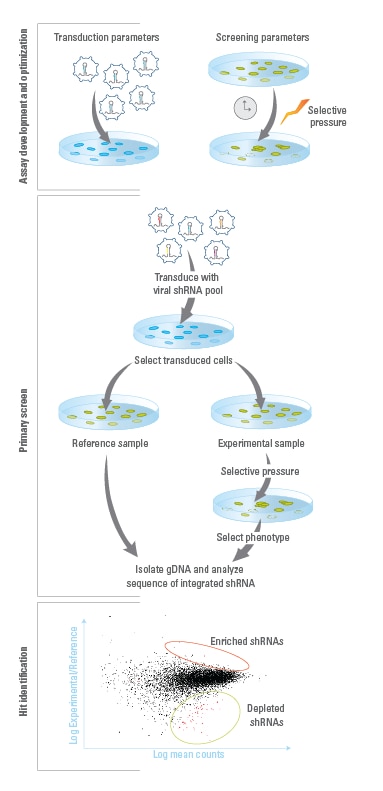
Assay Development and Optimization
Establish optimal experimental conditions, including those for a) lentiviral transduction and b) screening parameters, such as selective pressure and time between collection of reference and experimental samples.
Primary Screen
A stable population of cells expressing single integrants of constructs is created by transducing lentiviral pools at low MOIs. Transduced cells are then split into reference and experimental populations for application of a selective pressure that induces the phenotype of interest. Genomic DNA (gDNA) is then isolated from reference and experimental populations of transduced cells. Illumina-adapted primers and Phusion Hot-Start II High Fidelity DNA Polymerase are used to PCR amplify integrated construct sequences and add Illumina flow-cell binding sequences. The resulting amplicons are run on Illumina platform sequencers, using the sequencing primers provided.
Hit Identification and Follow-up
Construct sequences are identified in reference and experimental libraries. Constructs that are enriched or depleted during the screen are identified as hits, and the genes that they target are identified. Hits can be confirmed and studied further using individual constructs that can be ordered from the Dharmacon catalog collection.