





Edit-R CRISPR knock-out
Functional and specific gene knock-out
CRISPR knock-out is a gene editing technology that permanently changes genomic DNA at a desired location and completely disables the desired gene's function. Edit-R guides are algorithm-optimized and routinely updated to modern RefSeq annotations for generation of the most specific and genomically relevant guides. Our Edit-R guide RNAs are guaranteed to edit your target gene of interest so that you can be confident in your experiment.
Visit our application page to learn more about the Edit-R CRISPR-Cas9 gene editing system.

CRISPR knock-out guide RNA
-
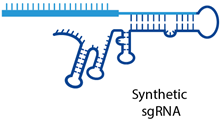
Synthetic sgRNA
Ready-to-use sgRNAs chemically modified for nuclease resistance and improved editing efficiency.
-
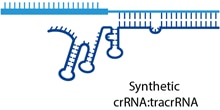
Synthetic crRNA
Must be used with synthetic tracrRNA. Chemically modified for nuclease resistance and improved editing efficiency.
-
Synthetic tracrRNA
For use with with synthetic crRNA. -
Lentiviral sgRNA
Stable guide RNA expression for cell types or workflows not amenable to transfection. -
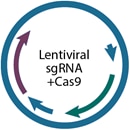
Lentiviral All-in-one sgRNA
Single reagent Cas9 + sgRNA in one vector for streamlined delivery.
-
Lentiviral and All-in-one lentiviral DyadGuide dual-sgRNA
Deliver two sgRNAs against one or two different genes in a single transduction with the DyadGuide™ dual-sgRNA platform.
CRISPR knock-out Cas9 nuclease
-
Cas9 mRNA
High purity Cas9 mRNA for transient Cas9 nuclease expression with fluorescent options for enrichment. -
Edit-R Cas9 protein hybrid NLS
High concentration purified Cas9 protein with novel NLS composition enabling more efficient RNP nuclear delivery. -
Cas9 protein NLS
Purified ready-to-use Cas9 protein for rapid RNP workflows. -
Lentiviral Cas9
Lentiviral particles with selection markers for constitutive Cas9 expression and in generating Cas9 expressing cells. -
Strict-R Cas9 inducible lentiviral system
Dual-controlled inducible lentiviral system for strict control over knock-out in diverse cell types. -
Cas9-expressing stable cells
Cas9-expressing stable cells in popular cell types. Pair with Edit-R CRISPR guide RNA for targeted gene knock-out.
Controls, additional reagents, and libraries
-
CRISPR knock-out controls
 Essential controls to enable successful CRISPR experiments.
 -
Transfection and transduction
 DharmaFECT™ transfection reagents and LentiBOOST™ transduction enhancers.
 -
CRISPR libraries
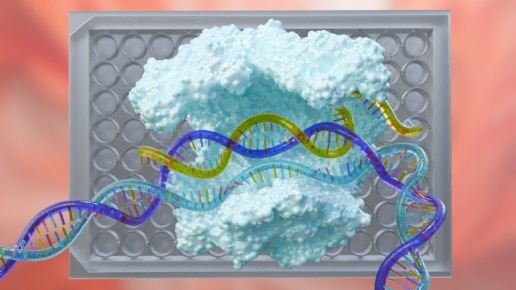 Investigate entire gene families or biological pathways with our broad suite of custom and predefined CRISPR libraries.
Why you should choose Dharmacon Edit-R CRISPR knock-out reagents?
Guide RNA
-
Functional and specific gene knock-out
Edit-R guide RNAs are designed using a validated algorithm to achieve functional gene knock-out with high specificity.
-
Guaranteed edits
Edit-R guide RNAs are guaranteed to edit the target gene-of-interest, so you can be confident in your knock-out results.
-
Genome wide designs
Edit-R guide RNAs are designed against the vast majority of genes in the human and mouse genome providing you convenient ready to use reagents.
-
Versatility in formats
Edit-R guides are available in a variety of synthetic and lentiviral formats maximizing possible experimental applications.
-
Updated to a modern RefSeq
Edit-R guides are routinely updated to modern RefSeq annotations for generation of the most specific and genomically relevant guides.
Cas9 nucleases
-
Broad format Cas9 options
A full range of Cas9 solutions designed to fit any CRISPR-based gene editing experiment.
-
Faster workflows
Faster workflows - "CRISPR-ready" Cas9-expressing stable cell lines in popular cell types to streamline your editing process.
-
Easy optimization & enrichment
Cas9 lentiviral and mRNA reagent options with fluorescent reporters (mKate2 or TurboGFP™) and antibiotic selection markers (PuroR, BlastR, or HygroR) simplify identification and enrichment of Cas9-expressing cells.
-
Reduced off-targets
Transient Cas9 mRNA or protein reagents minimize off-target effects and protect cells from unwanted responses - no DNA required.
-
Flexible delivery
Lentiviral Cas9 (constitutive or Strict-R inducible) eliminates the need for cytotoxic transfection or electroporation.
Flexibility to fit your workflow
We offer Dharmacon Edit-R CRISPR guide RNA in a variety of formats to fit many different experimental workflows.
 |
 |
 |
 |
- Synthetic single guide (sgRNA) or two-part crRNA:tracrRNA reagents can be co-transfected with Cas9 mRNA or protein for DNA-free workflows.
- Lentiviral sgRNA are recommended for editing in difficult-to-transfect cells.
- All-in-one lentiviral sgRNA + Cas9 offers a single-reagent knock-out workflow.
- Lentiviral and All-in-one lentiviral DyadGuide dual-sgRNA enable efficient expression of two sgRNAs in a single vector using a novel bidirectional U6 promoter.
- Custom design synthetic or lentiviral guide RNAs for additional species, alternative nucleases or any target location using the CRISPR Design Tool.
Scale to meet any scope
Expand the scope of your next loss-of-function experiment. Use the Cherry-Pick Library Tool to design and order your own custom CRISPR knock-out screening library of Edit-R guide RNA reagents. Or see our predefined CRISPR knock-out libraries for gene families or whole genome screens.
Cas9 nuclease selection guide
Determining the most appropriate Cas9 nuclease reagent for your experiment is dependent on the particular application or cell type.
See the table below to determine the best format for your experiment.
| Cas9 protein | Cas9 mRNA | Lentiviral Cas9 particles | |
|---|---|---|---|
| DNA-free, transient expression | ✔ | ✔ | |
| Co-electroporate with synthetic guide RNA | ✔ | ✔ | |
| Co-transfect with synthetic guide RNA | ✔ | ✔ | |
| Enrich population with FACS | ✔ | ✔ | |
| Enrich population with resistance marker | ✔ | ||
| *NEW* Strict-R inducible expression | ✔ | ||
| Create stable cell lines | ✔ | ||
| Lentiviral transduction for cells that are difficult to transfect | ✔ |
Guide RNA reagent selection
Determining the most appropriate guide RNA format for your experiment will depend on your particular application and cell type. Use this table to select the right reagents for your specific experimental conditions.
| Synthetic sgRNA | Synthetic crRNA: tracrRNA | Lentiviral sgRNA | All-in-one lentiviral sgRNA | New: Lentiviral and All-in-one lentiviral dual-sgRNA | |
|---|---|---|---|---|---|
| Guaranteed to edit your gene of interest | ✔ | ✔ | ✔ | ✔ | ✔ |
| Can be custom designed for any species, nuclease or editing location | ✔ | ✔ | ✔* | ✔* | |
| RNP compatible for electroporation | ✔ | ✔ | |||
| Transduce into difficult-to-edit cells that can't be electroporated | ✔ | ✔ | ✔ | ||
| Population enrichment with antibiotic resistance markers | ✔ | ✔ | ✔ | ||
| Population enrichment with fluorescent markers | ✔** | ✔** | ✔ | ✔*** | |
| Single reagent delivery for sgRNA and Cas9 in the same vector | ✔ | ✔ | |||
| Single reagent delivery for multiple sgRNAs with or without Cas9 | ✔ |
*custom vector designs for use with S. pyogenes Cas9 only.
**when co-transfected with fluorescent Cas9 mRNA.
***when using All-in-one formats
Supporting data
-
Edit-R sgRNA data
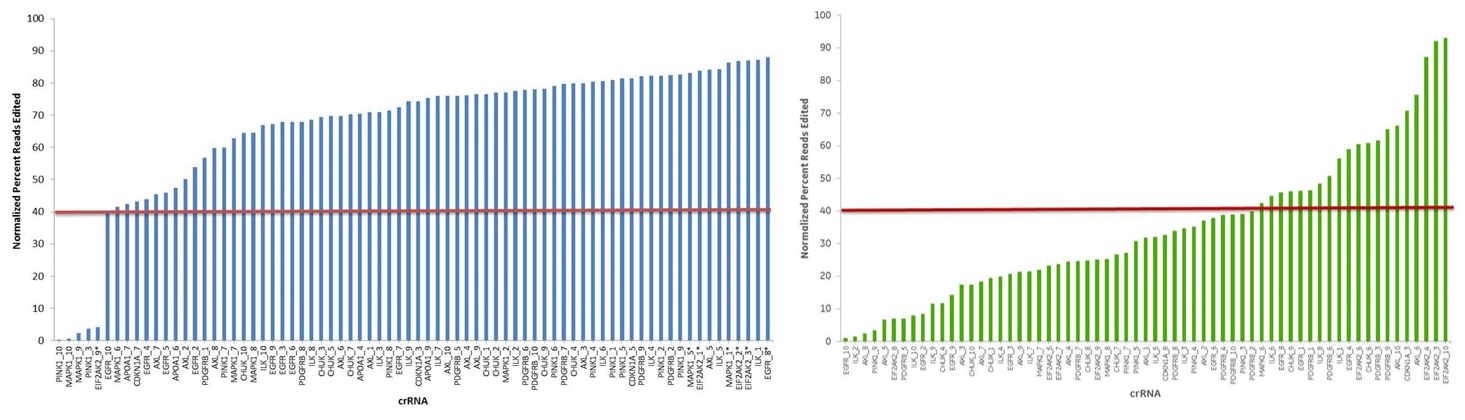
Edit-R algorithm scores correlate to cleavage efficiency
10 crRNAs with high functional scores for 10 genes (blue bars) and 10 crRNAs with low functional scores for the same genes (yellow bars) were tested for editing by Next Generation Sequencing. 93% of the high-scoring crRNAs and 32 % of the low scoring crRNAs showed > 40% of editing (indel formation). The Cas9-HEK293T cell line was transfected with 50 nM crRNA:tracrRNA, using 0.25 µL/well of DharmaFECT 1. Seventy-two hours post-transfection, cells were lysed and Nextera transposon-adapted amplicons spanning each crRNA site were generated for every treated sample as well as for a matched control amplicon from untransfected samples. Samples were indexed using the Nextera 96-well index kit and pooled for sequencing on a MiSeq instrument (paired end reads, 2 x 300 length). Reads that passed NGS quality filtering criteria were aligned to the reference file (Bowtie2 v2.1.0). Percent perfect reads were calculated and normalized to the control untransfected samples (Samtools v0.1.12a); the data is presented as normalized percent edited.
-
Flow cytometry analysis of protein knockout in CD4+ T cells
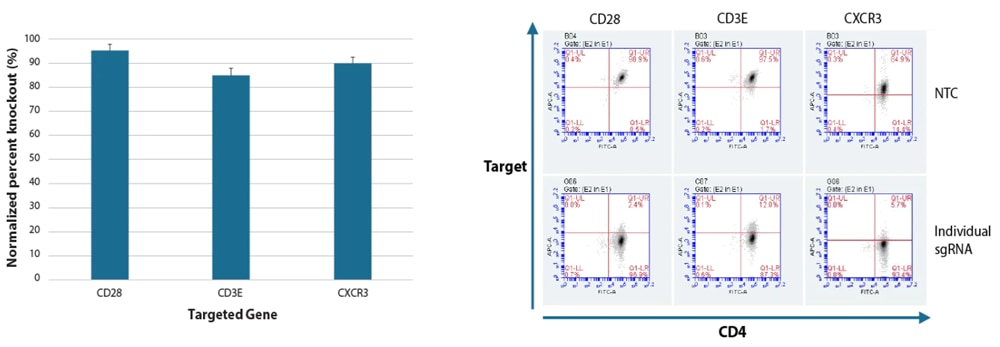
Flow cytometry analysis of protein knockout in CD4+ T cells using a single predesigned synthetic sgRNA per gene target
Primary human CD4+ T cells were nucleofected with Cas9 RNP using an individual predesigned synthetic sgRNA per gene target or a non-targeting control (NTC), via a Lonza 96-well Shuttle system. After 72 hours, functional knockout of CD28, CD3E, and CXCR3 were assessed as a percent of cells not expressing the target gene by FACS analysis. Cells were stained and normalized for CD4 expression using an Alexa Fluor 488 conjugated antibody and compared to each target CD28, CD3E, and CXCR3 using APC conjugated primary antibodies.
-
Efficient indel formation using Edit-R synthetic sgRNA in Cas9-expressing stable cell lines
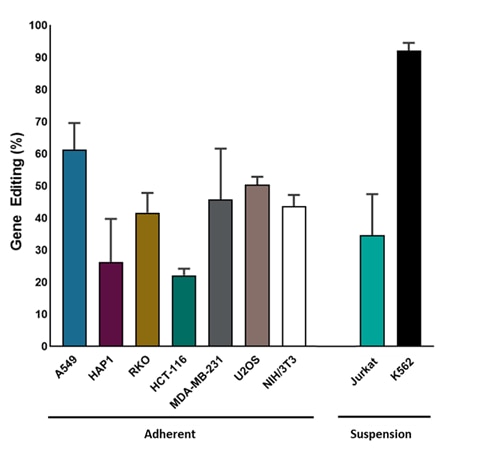
Adherent Cas9 Stable Cell Lines were plated at 10,000 cells/well and reverse-transfected using DharmaFECT1 or DharmaFECT4 Transfection Reagent with synthetic sgRNA (25 nM) targeting PPIB (Cat # U-009000-01-XX). Cells were harvested 72 hours post-transfection, and the relative efficiency of indel formation was assessed using trace decomposition (TIDE) compared to a non-targeting control (NTC; Cat # U-009501-01-XX). Suspension Cas9 Stable Cell Lines were electroporated using 100,000 cells/well, and Lonza buffer SE or SF, respectively, with synthetic sgRNA (5 µM) targeting PPIB (Cat # U-009000-01-XX). Cells were harvested 72 hours post-transfection and the relative efficiency of indel formation was assessed using trace decomposition (TIDE) compared ion to a non-targeting control (NTC; Cat # U-009501-01-XX).
-
Cas9 mRNA data
Fluorescent Cas9 nuclease mRNA maintains editing efficiency
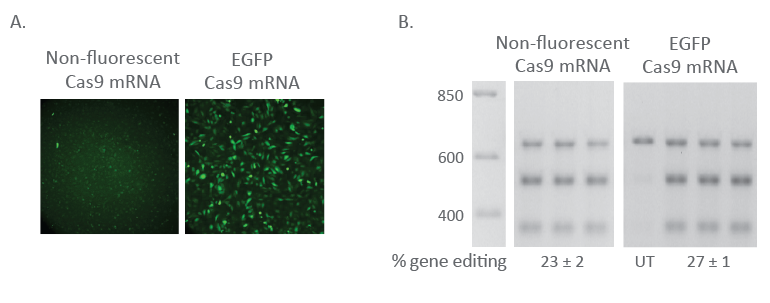
Fluorescent Cas9 mRNA U2OS cells were plated at 10,000 cells/well in a black 96-well plate 24 hours before transfection. At the time of transfection, EGFP Cas9 nuclease mRNA (200 ng, Cat #CAS11860) or non-fluorescent Cas9 Nuclease mRNA (200 ng, Cat #CAS11195) was co-transfected with Edit-R PPIB Synthetic crRNA Control (25 nM, Cat #U-007000-01-05) and tracrRNA (25 nM, Cat# U-002005-05) using DharmaFECT™ Duo transfection reagent (0.3 µL/well). After 24 hours, cells were imaged for EGFP fluorescence using the Nikon Eclipse Ti-S/L100 inverted microscope (A). At 72 hours after transfection, cells were harvested and gene editing was measured through a DNA mismatch detection assay (B).
Fluorescent Cas9 nuclease mRNA indicates optimal transfection conditions
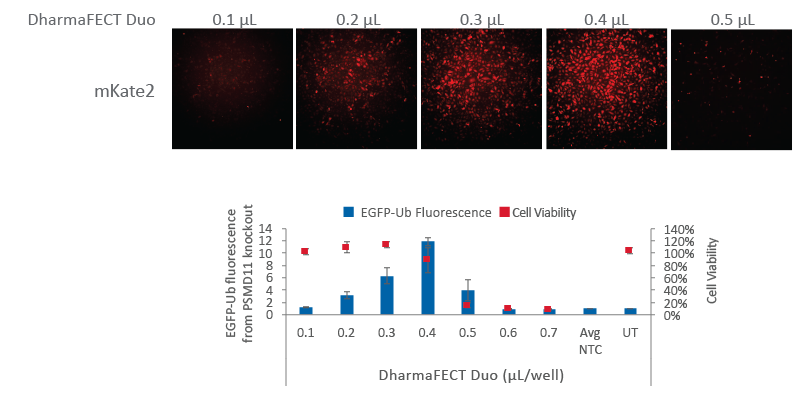
U2OS cells expressing a Ubiquitin-tagged EGFP were plated at 10,000 cells/well in a black 96-well plate and co-transfected with Cas9 mRNA (200 ng, Cat #CAS11859) and synthetic tracrRNA (25 nM, Cat# U-002005-05) targeting PSMD11 (25 nM, Cat #CM-085161-03), a known proteasome component, or a Non-targeting control (NTC, Cat #U-007501-xx). Increasing amounts of DharmaFECT Duo Transfection Reagent were tested per well (0.1 µL to 0.7 µL). After 24 hours, cells were imaged for mKate2 fluorescence using the In Cell Analyzer 2200. At 72 hours after transfection, cells were imaged for EGFP fluorescence resultant from proteasome knockout. Based on mKate2 fluorescence, optimal transfection conditions occur at 0.3-0.4 µL of DharmaFECT Duo per well, which corresponds to an increased phenotypic effect. Above 0.4 µL of DharmaFECT Duo per well, significant cell death is observed (graph, red boxes). UT = untransfected sample.
-
Cas9 protein data
Nucleofection of CD4+ primary human T-cells with Edit-R Cas9 Protein Hybrid NLS RNPs
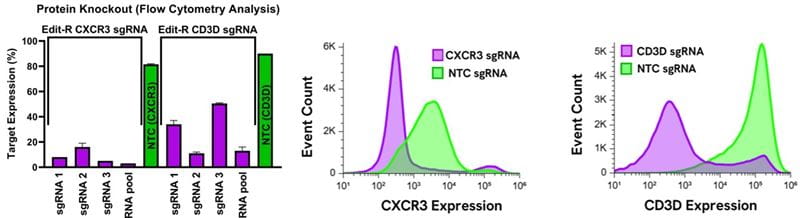
CD4+ cells were stimulated with CD3/CD28 T-cell activation beads (BioLegend) at a 1:1 bead:T-cell ratio and grown for 8 days with 30 U/mL of IL-2. The Lonza 4D shuttle system was used to nucleofect RNPs composed of Edit-R Cas9 Protein Hybrid NLS and Edit-R synthetic guide RNA individual and target pools for CXCR3 (Gene ID: 2833) and CD3D (Gene ID: 915). Functional knockout was measured by flow cytometry analysis of target prevalence for CXCR3 (Clone ID: G025H7) and CD3D (Clone ID: OKT3) (BioLegend). Representative flow cytometry analysis plots of CD4+ T-cells shown after target knockdown by RNP nucleofection.
-
Lentiviral Cas9 data
Fluorescent lentiviral Cas9 nuclease enables enrichment for high expression and improved CRISPR-Cas9 gene editing efficiency
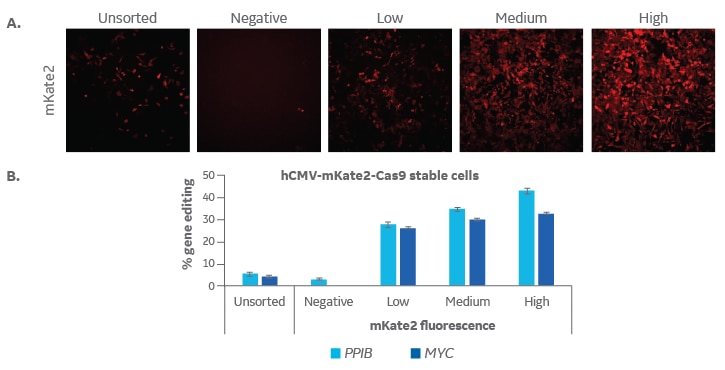
U2OS cells were transduced at low multiplicity of infection (MOI 0.3) with Edit-R Lentiviral hCMV mKate2-Cas9 Nuclease particles (Cat #VCAS11869) so that transduced cells would have only one integration of Cas9. Cells were expanded for fluorescence activated cell sorting (FACS) where populations were sorted into negative, low, medium and high mKate2 fluorescence. These subpopulations were expanded and then plated at 10,000 cells/well in a 96-well plate. One day later, cells were transfected with tracrRNA (25 nM, Cat #U-002005-xx) and Edit-R PPIB Synthetic crRNA Control (Cat #U-007501-xx) or Edit-R MYC Predesign crRNA (Cat #CM-003282-01) using DharmaFECT 1 transfection reagent (0.3 µL/well, Cat #T-2001-01). After 72 hours, cells were imaged for mKate2 fluorescence using the In Cell Analyzer 2200 (GE Healthcare; A) and then harvested for DNA mismatch detection assay to estimate gene editing (B). High mKate2 expression can be associated with the highest levels of gene editing for both PPIB- and MYC-targeting crRNAs.
Guarantee
We guarantee that EVERY predesigned guide RNA will provide successful editing at the target site when delivered as described in the Edit-R technical manuals.
The Edit-R guide RNA guarantee is valid when used with any wild type S. pyogenes Cas9 nuclease, including mRNA, expression plasmid, protein, or stable Cas9 expression, and Edit-R crRNAs must be used with Edit-R tracrRNA for the guarantee to apply.
Analysis of editing of the treated cell population must be shown using a T7EI or Surveyor mismatch detection assay. If successful editing is not observed for a predesigned Edit-R guide RNA while an appropriate side-by-side Edit-R positive control is successful, a one-time replacement of a different predesigned Edit-R guide RNA of the same format and quantity will be provided at no cost.
A replacement will only be approved upon discussion with our Scientific Support team.
Successful editing at the DNA level does not always lead to functional gene knock-out; it is recommended to test multiple guide RNAs to determine the most effective guide RNA for knock-out of your target gene.
This guarantee does not extend to any accompanying experimental costs, does not apply to guide RNAs ordered via the CRISPR Design Tool, and will not be extended to the replacement guide RNA.