





Our website has a fresh new "look"
We've updated our site with modern design and easier navigation, but you'll still find the same quality Dharmacon™ reagents and Mimix™ reference standards that you love.
Lincode Non-targeting Control siRNAs

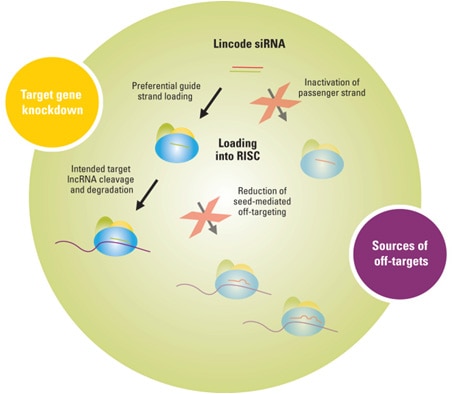
Lincode Non-targeting Control siRNAs are ideal negative controls for RNAi experiments for knockdown of human long, noncoding RNAs (lncRNAs). Each of the four available Lincode Non-targeting siRNAs are designed to leverage seed-region optimization and proprietary dual-strand modification patterns to have fewer off-targets than traditionally designed negative control siRNAs. Changes in cells treated with these controls reflect a baseline cellular response that can be compared to the levels in cells treated with target-specific siRNA.
Highlights
- Ideal negative control for RNAi experiments in human, mouse, and rat cells
- Chemically matched for use with Lincode siRNA reagents
- Screened by genome-wide microarray analysis for minimal off-targets
Note
These controls are identical to the ON-TARGETplus Non-targeting siRNAs 1-4 (Cat# D-001810-01, -02, -03, -04). They are also being sold under the Lincode name for ease of ordering by customers new to RNAi. Either catalog item is suitable for Lincode and ON-TARGETplus siRNA experiments.