Product Insert
Option A1 custom siRNA synthesis
Option A1 custom siRNA synthesis product insert, containing contents, protocol, shipping and storage conditions, handling precautions, etc.






We've updated our site with modern design and easier navigation, but you'll still find the same quality Dharmacon™ reagents and Mimix™ reference standards that you love.
siRNA customization has never been easier
No pre-designed product to fit your needs? Our Dharmacon™ online design tools and extensive synthesis options make it simple to create a custom siRNA tailored to your specific application. Choose from numerous combinations of modifications, synthesis scales, and purification options - all available for convenient online ordering.

Order custom siRNA
Custom SMARTpool™ design and synthesis
siDESIGN center
Order plated custom siRNA
Other custom siRNA needs
Learn how to use the Dharmacon custom siRNA synthesis tool to design and order custom siRNA for your research.
Access to internal siRNA design specialists for complex projects, new modifications, assymetric designs with our Scientific Support team
Choose from phosphorothioate linkages, 2'-O-methyl, 2'-fluoro, conjugation handles and fluorescent labels, and more options to enhance stability and function. A full list of modifications available on our web ordering tools can be found at our Bases and Modifications page.
Blunt-ended, longer duplexes (>23 nt), mismatched strands, and alternative bases or linkages
ON-TARGETplus dual-strand modification dramatically reduces off-target effects
siSTABLE and Accell modifications resist nuclease degradation for in vivo applications
Accell siRNA enables gene silencing in difficult-to-transfect cells without reagents
ON-TARGET modification ensures correct antisense strand uptake by RISC
Numerous combinations of modifications, sizes, and purification options available.
Custom siRNA delivered in ready-to-use 96-well plates to streamline setup.
Request tailored quotes for specifications not available through online ordering.
Our siRNA design experts can provide custom SMARTpools of 4 siRNAs targeting genes outside of our genome-wide offerings.
All oligos made by the Dharmacon Reagents team are examined by mass spectrometry. Additionally, ultra-HPLC analytical data and Mass-spec traces are available on request as an additional service.
Request modifications or customized purification and processing beyond the standard catalog or get design guidance from our team. contact our Scientific Support team.
If you are working in human, mouse or rat models, we may already have what you need as a pre-designed product: Search for your gene in the Search field found in the upper right corner. In addition, our siDESIGN Center is an advanced tool that can help identify functional siRNA for your unique needs and create unique sequences against your target of interest. Learn more about the capabilities of the siDESIGN Center with the User Guide.
Take advantage of our internal design experts and SMARTpool technology! Order a functionally guaranteed Custom SMARTpool for worry-free customization.
Alternative siRNA designs that we support include:
Blunt-ended
Asymmetrical
Longer duplexes (>23 nt)
Mismatched strands
Alternative bases or linkages
If you can't find what you need or you require additional specifications not available through online order, please request a quote. Need additional help? Please contact Scientific Support
Extensive modification options:
We offer a wide selection of chemical modifications, including a variety of fluorophores and functional groups. These can be applied to single-strand RNA, DNA, RNA-DNA chimeras, siRNA, ASO, and microRNA oligos. Modifications available on our web ordering tools can be found at our Bases and Modifications page.
Standard modifications offered include:
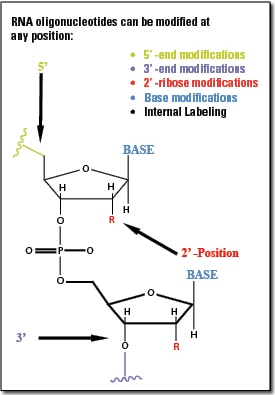
Modified bases such as 2'-O-methyl bases
Pseudouridine (~U)
Fluorescent labels and quenchers
Terminal linkers and functional groups for conjugation chemistries
Phosphorothioate backbone modifications (*)
View our web-tool enabled Bases and Modifications
NOTE: Many other modifications are available upon request. The online ordering tools only include a subset of common modifications. For assistance please contact Scientific Support.
NOTE: siRNA can be modified at either end of either strand. Multiple modifications can be supported, but availability and feasibility may be dependent upon sequence or other factors. Please contact Scientific Support for more information.

Note: All siRNA modifications, proprietary and other, are available through custom siRNA synthesis webtools.
| ON-TARGET | ON-TARGETplus | Accell | siSTABLE | |
|---|---|---|---|---|
| Inhibits sense (passenger) strand uptake by RISC | ✔ | ✔ | ✔ | ✔ |
| Antisense strand seed region modified for greater specificity to target | ✔ | |||
| Resistant to endo-and exonuclease degradation | ✔ | ✔ | ||
| Delivery into cells without transfection reagent | ✔ | |||
| Also available as Pre-designed siRNA | ✔ | ✔ |
|
|
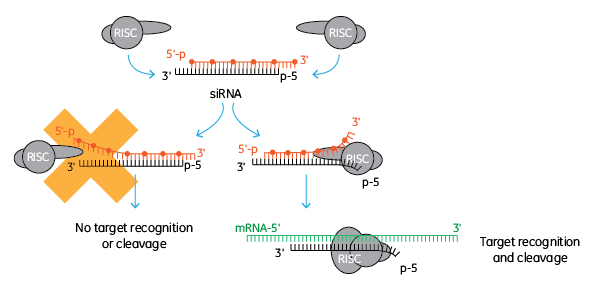
The ON-TARGET modification promotes correct strand uptake by blocking the sense (passenger) strand from being taken up by the RISC process. This is a useful method for ensuring antisense (guide) strand processing. All proprietary siRNA modifications (ON-TARGETplus, Accell, siSTABLE) incorporate this sense-strand modification to promote antisense (guide) strand-facilitated silencing. |
|
|
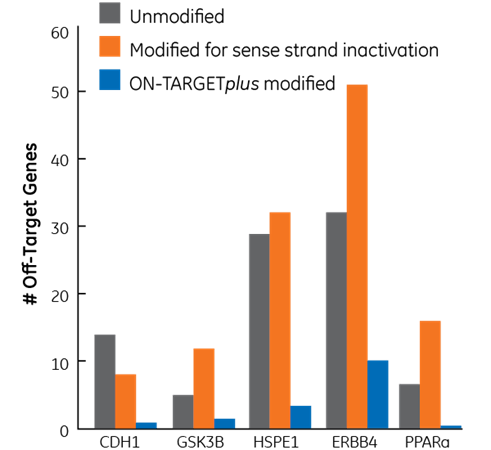
A 2006 publication demonstrates that off-target effects are primarily driven by antisense strand seed activity.1 Therefore, sense strand inactivation alone does not decrease the total number of off-target genes. ON-TARGETplus modifications account for both strands:
The ON-TARGETplus modification pattern dramatically reduces off-targets. Off-target effects induced by the indicated siRNAs were quantified using microarray analysis. For each target, three different siRNAs were used: unmodified, sense strand-inactivated, and ON TARGETplus-modified. Data shown represents genes down-regulated by two-fold or more. HEK293 cells were transfected with 100 nM siRNA using 0.2 µL of DharmaFECT 1. Data was analyzed at 24 hours. 1 Jackson, A.L. et al. "Position-specific Chemical Modification Increases Specificity of siRNA-mediated Gene Silencing." RNA 12.7 (2006) 1197-1205. |
|
|
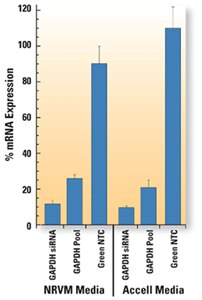
Neonatal rat ventricular myocytes were incubated with 1 µM Accell Green (A; Cat# D-001950-01) or Red (B; Cat# D-001960-01) Non-targeting siRNA for 72 hours in Accell delivery media (Cat# B-005000). Nuclei were stained with DAPI (blue). Labeled control uptake showed diffuse cytoplasmic localization in nearly all cells. The bar graph indicates the level of gene silencing achieved with Accell GAPD Control siRNA (Cat# D-001930-03) and Pool (Cat# D-001930-30) control reagents when used with neonatal rat ventricular myocyte (NRVM) media or Accell delivery media. Myocytes were prepared as described in Maass AH & Buvoli M. Cardiomyocyte preparation, culture, and gene transfer. Methods Mol Biol. 2007;366: 321-30. mRNA expression was determined by QuantiGene branched DNA assay (Panomics). |
|
|
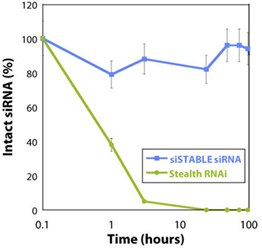
Conventional siRNA is degraded within minutes in serum-containing environments, making in vivo use of siRNA problematic. This graph presents evidence that the siSTABLE modification pattern dramatically extends the half-life of siRNA in the presence of 100% human serum as compared to Stealth RNAi (Invitrogen). Accell siRNA also includes these stability-enhancing modifications, as well as providing delivery to difficult-to-transfect cells without a transfection reagent. |
We want your in vivo experiments to have the best chance of success. To assist you in your experimental planning, we offer the following options and guidance:
We recommend identifying a highly functional siRNA design in vitro prior to initiating expensive experiments using animal models
A predesigned set of 4 siRNA reagents is ideal for testing multiple siRNA sequences
Individual duplexes: Four individual siRNAs are pre-designed for every gene in human, mouse and rat. Order 1, 2, 3 or 4.
SMARTpool™ format: All four siRNAs are pooled together as a single reagent in one tube.
Set of Four: All four siRNAs are provided as individual duplexes in four individual tubes.
Consider the number of animals in each cohort, the number of treatments or doses that will be required, and the amount of siRNA required for each dose
In vivo experiments typically require a large quantity of siRNA. Synthesis capabilities can accommodate up to 10 grams by request, or up to 100 mg available online
Need help converting nmol to mg? Check our siRNA yield table.
We routinely achieve 80-85% purity for unmodified siRNA strands without additional purification.
However, purification may be recommended when chemically synthesized siRNAs are:
Chemically modified at the 3' end or internally
Dually modified on the same strand
Intended for use in highly sensitive assays or in vivo applications
Please contact Scientific Support for information regarding recommendations for purification or purity estimates for unpurified material.
| Single Strands (A1) | Standard (A4) | HPLC | In vivo | In vivo HPLC | |
|---|---|---|---|---|---|
| Desalted | ✔ | ✔ | ✔ | ✔ | |
| Deprotected | ✔ | ✔ | ✔ | ✔ | |
| Duplexed | ✔ | ✔ | ✔ | ✔ | |
| Purified | ✔ | ✔ | |||
| Endotoxin tested | ✔ | ✔ | |||
| Sodium counter-ion exchange | ✔ | ✔ | |||
| Recommended for modified siRNA (dyes, etc.) | ✔ | ✔ | |||
| Recommended for in vivo use | ✔ | ✔ | |||
| 2'ACE protected single-strands | ✔ |
Desalted: The siRNA duplex has been desalted by either ethanol precipitation or C18 column desalting
Deprotected: The 2'-ACE protecting groups of the RNA bases have been removed (deprotected)
Duplexed: The two complementary siRNA strands have been annealed to form a duplex
Single-strand (A1): The siRNA is provided with the sense and antisense strands in separate tubes; individual strands have NOT been desalted or deprotected
Standard (A4): The siRNA is provided as a desalted & deprotected duplex, ready to use upon resuspension
HPLC: The duplex has undergone ion exchange High Performance Liquid Chromatography for purification
In vivo: The duplex has been processed by counter-ion (Na+) exchange, desalting, sterile filtration, and endotoxin testing
In vivo HPLC: The duplex has undergone both in vivo processing as well as HPLC purification
| Standard (A4) | Standard (A4) | HPLC purified | HPLC purified | in vivo | in vivo | in vivo HPLC | in vivo HPLC | ||
|---|---|---|---|---|---|---|---|---|---|
| nmol | mg | nmol | mg | nmol | mg | nmol | mg | ||
| 0.025 µmol scale | 20 | 0.25 | - | - | - | - | - | - | |
| 0.05 µmol scale | 40 | 0.5 | 20 | 0.25 | 25 | .3 | - | - | |
| 0.2 µmol scale | 150 | 2 | 80 | 1 | 100 | 1.3 | 50 | 0.65 | |
| 0.4 µmol scale | 300 | 4 | 160 | 2 | 200 | 2.6 | 100 | 1.3 | |
| 1.0 µmol scale | 750 | 10 | 320 | 4 | 500 | 6.6 | 250 | 3.3 | |
| 2.0 µmol scale | 1500 | 20 | 750 | 10 | 1000 | 13 | 500 | 6.6 | |
| 5.0 µmol scale | 3750 | 50 | 1875 | 25 | 2500 | 33 | 1250 | 16 | |
| 10.0 µmol scale | 7500 | 100 | 3750 | 50 | 5000 | 66 | 2500 | 33 |
Learn about important considerations for in vivo studies with RNAi
Try using our Dharmacon Oligo Sequence Converter.
Access our Ordering and calculation tools page for convenient webtools to support everything from designing your own siRNA or CRISPR guide against any organism to analyzing your PCR primers.
Revvity's Dharmacon Reagents team adheres to the guidelines in the United States Framework For Nucleic Acid Synthesis. For more information please see our self-attestation.