- Gene modulation
- RNA interference
- Accell 2.0 Red Non-targeting Control siRNA
Accell 2.0 Red Non-targeting Control siRNA
Accell 2.0 Red Non-targeting Control siRNA is a fluorescent negative control designed to support qualitative assessment of siRNA uptake. The siRNA incorporates a Cy3 label, enabling visualization of cytoplasmic localization to support evaluation of Accell siRNA delivery.
The sequence is designed to minimize complementarity to known genes in human, mouse, or rat, supporting assessment of non-sequence-specific effects.
Aligned with the next-generation Accell 2.0 design strategies, Accell siRNA is formulated for uptake in difficult-to-transfect cells without the use of transfection reagents or viral vectors.
Accell 2.0 Red Non-targeting Control siRNA is a fluorescent negative control designed to support qualitative assessment of siRNA uptake and baseline cellular responses. The siRNA incorporates a Cy3 label, enabling visualization of cytoplasmic localization by fluorescence microscopy and assessment of uptake by flow cytometry.
Non-targeting siRNA reagents are commonly used to support interpretation of RNAi experiments by providing a reference for non-sequence-specific effects. The sequence is designed to minimize complementarity to known genes in human, mouse, or rat.
Aligned with the next-generation Accell 2.0 design strategies, Accell siRNA is formulated for uptake in difficult-to-transfect cells without the use of transfection reagents or viral vectors.
Highlights
- Designed to minimize complementarity to known genes in human, mouse, and rat
- Chemically modified siRNA to support uptake, stability, and target engagement
- Modifications support stability against nuclease-mediated degradation
- Cy3 label (Abs/Em: 547/563 nm); compatible with Cy3, Rhodamine, or PE filter sets
Experimental considerations
- Working concentration: ~1 µM commonly recommended
- Serum conditions: Delivery may be reduced in the presence of high serum or BSA; optimization using serum-free media or ≤2.5% serum is recommended
- Incubation timeline: Full-serum media can be added after ~48 hours; mRNA silencing is often observed around ~72 hours, with protein knockdown typically observed between 72–96 hours (target dependent)
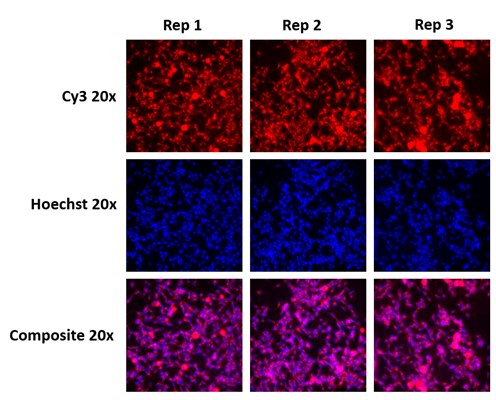
Efficient delivery of Accell Red Non-targeting Control siRNA
Uptake of Accell siRNA confirmed by fluorescence microscopy. SH-SY5Y cells were treated with 1 µM Accell red non-targeting control siRNA in Accell delivery media.
| Peer-reviewed publications demonstrate effective silencing in numerous cell types | |
|---|---|
| Human Suspension Cell Lines | BDCM, IM-9, Jurkat, K662, THP-1, Jeko-1 and Mino MCL |
| Human Adherent Cell Lines | A-375, ARPE-19, CaCo-2, CG4, DLD-1, DU-145, EC52, GTM-3, MR32, LAN5, LNCaP, MIA PaCa-2, NCI/ADR-RES, OVCAR-3, OVCA-420, PGA1, PNT2, SH-SY5Y, SK-N-BE and SK-N-SH neuroblastoma, SK-BR3, SKOV3, TE15, U251, U87MG, U937 |
| Mouse Adherent Cell Lines | ES-D3, H9c2, LbT2, LNK, mouse oviduct epithelial cells, mProx24, PC-12 |
| Human Differentiated Stem Cells | Adipocytes and osteoblasts from hMSC |
| Human Primary Cells | HUVEC, HUASMC, hMSC, PBMC, astrocytes, hypothalamic neurons, T cells, NK cells, macrophages, immortalized B cells, esthesioneuroblastoma cells, hepatocytes, bronchial smooth muscle cells |
| Mouse and Rat Primary Cells | Cortical neurons, hippocampal neurons, striatal neurons, Naïve CD4+ T cells, LN T cells, D1 T cells, RAW264.7 macrophages, hepatocytes, neonatal ventricular cardiomyocytes, fibroblasts derived from genetically-modified mice, bone marrow-derived DC, NOD CD4+ CD25- splenic cells, NOD BMMs, VSMCs, somatolactotroph GH3, McArdle 7777 cells (hepatoma cell line), osteoclast precursors, calvarial (cranial) organ, pituitary cell types derived from primary tumors |
| In vivo Animal Applications | Please contact Scientific Support for guidance |

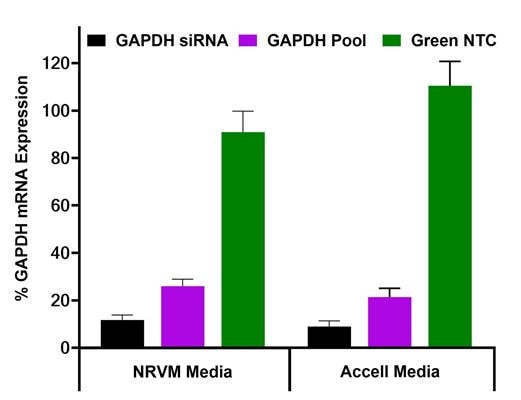
Gene silencing in cardiomyocytes using Accell control siRNA and Accell delivery media or low serum NRVM media
Neonatal rat ventricular myocytes were incubated with 1 μM Accell Green (Cat# D-001950-01) Non-targeting siRNA for 72 hours in Accell delivery media (Cat# B-005000). Labeled control uptake showed diffuse cytoplasmic localization in nearly all cells (data not shown). The bar graph indicates the level of gene silencing achieved with Accell Rat GAPD siRNA Control (Cat# D-001930-03) and Accell Rat GAPD siRNA Control Pool (Cat# D-001930-30) when used with neonatal rat ventricular myocyte (NRVM) media or Accell delivery media. Myocytes were prepared as described in Maass AH & Buvoli M. Cardiomyocyte preparation, culture, and gene transfer. Methods in Molecular Biology 2007;366: 321-30. mRNA expression was determined by QuantiGene branched DNA assay (Panomics).
View the published references citing successful Accell siRNA application.
Accell siRNA reagents in neuronal cells
- A. Vagnoni et al., Calsyntenin-1 mediates axonal transport of the amyloid precursor protein and regulates Aß production. Human Molecular Genetics.21, 13 2845–2854 (2012). [rat primary cortical neurons (E18)]
- S. Suzuki et al., Differential Roles of Epac in Regulating Cell Death in Neuronal and Myocardial Cells.J. Biol. Chem.285, 24248-24259 (Jul 2010). [primary mouse cortical neurons (E15-17)]
- A. M. Dolga et al., TNF-alpha-mediates neuroprotection against glutamate-induced excitotoxicity via NF-kappaB-dependent up-regulation of K2.2 channels.J. Neurochem.107(4), 1158-1167 (November 2008). [mouse primary cortical neurons]
- U. Dreses-Werringloer et al., A Polymorphism in CALHM1 Influences Ca2+ Homeostasis, Ab Levels, and Alzheimer’s Disease Risk.Cell.133(7), 1149-1161 (27 June 2008). [SHSY-5Y; human neuroblastoma]
- J. Sebo et al., Requirement for Protein Synthesis at Developing Synapses.J. Neurosci.29(31), 9778-9793 (5 August 2009). [rat primary hippocampal neurons]
- P. Mergenthaler et al., Mitochondrial hexokinase II (HKII) and phosphoprotein enriched in astrocytes (PEA15) form a molecular switch governing cellular fate depending on the metabolic state.PNAS USA.109(5), 1518-1523 (31 January 2012). [extended duration silencing in rat primary cortical neurons]
Accell siRNA reagents in immunological cells
- D. Smirnov et al., Genetic Analysis of Radiation-induced Changes in Human Gene Expression.Nature.459(7246), 587-591 (28 May 2009). [immortalized B cells]
- V. Saini et al.,CXC Chemokine Receptor 4 Is a Cell Surface Receptor for Extracellular Ubiquitin.J. Biol. Chem.285(20), 15566-15576 (14 May 2010). [THP-1 monocytes]
- J. W. Perry et al., Endocytosis of Murine Norovirus 1 into Murine Macrophages Is Dependent on Dynamin II and Cholesterol.J. Virol.84(12), 6163-6176 (June 2010). [murine macrophages]
- M. Steenport et al., Matrix Metalloproteinase (MMP)-1 and MMP-3 Induce Macrophage MMP-9: Evidence for the Role of TNF-a and Coclooxygenase-2.J. Immunology.183(12), 8119-8127 (15 December 2009) [RAW264.7 macrophages, doi:10.4049/jimmunol.0901925]
- C. B. Lai et al., Creation of the two isoforms of rodent NKG2D was driven by a B1 retrotransposon insertion.Nucleic Acids Res. (2009). [mouse NK cell line, gkp174]
- N. Mookherjee et al., Intracellular Receptor for Human Host Sefense Peptide LL-37 in Monocytes.J. Immunol.183(4), 2688-2696 (15 August 2009). [THP-1; human monocytes]
- D. Smirnov et al., Genetic Analysis of Radiation-induced Changes in Human Gene Expression.Nature.459(7246), 587-591 (28 May 2009). [immortalized B cells]
- A. M. McElligott et al., The Novel Tubulin-Targeting Agent Pyrrolo-1,5-Benzoxazepine-15 Induces Apoptosis in Poor Prognostic Subgroups of Chronic Lymphocytic Leukemia.Cancer Research.69(21), 8366-8375 (13 October 2009). [PGA-1; EBV-transformed chronic lymphocyctic leukemia (CLL) B cell line, 10.1158/0008-5472.CAN-09-0131]
Accell siRNA reagents in vivo
- H. Nakajima et al., A rapid, targeted, neuron-selective, in vivo knockdown following a single intracerebroventricular injection of a novel chemically modified siRNA in the adult rat brain.J. Biotechnology.157(2), 326-333 (20 January 2012). [brain injection]
- E. Gonzalez-Gonzalez et al., Silencing of Reporter Gene Expression in Skin Using siRNAs and Expression of Plasmid DNA Delivered by a Soluble Protrusion Array Device (PAD).Molecular Therapy. 18(9), 1667-1674 (September 2010). [mouse intradermal injection, doi:10.1038/mt.2010.126]
- P. Bonifazi et al., Intranasally Delivered siRNA Targeting PI3K /Akt /mTOR Inflammatory Pathways Protects from Aspergillosis.Mucosal Immuno. 3(2), 193-205 (18 November 2009) [doi:10.1038/mi.2009.130, in vivo intranasal delivery]
- A. DiFeo et al., KLF6-SV1 Is a Novel Antiapoptotic Protein That Targets the Bh6-Only Protein NOXA for Degradation and Whose Inhibition Extends Survival in an Ovarian Cancer.Model Cancer Res.69(11), 4733–4741 (12 May 2009). [in vivo mouse model]
- Q. Li et al., Silencing MAP Kinase-activated Protein Kinase -2 Arrests Inflammatory Bone Loss.J. Pharmacol. Exp. Ther.336(3), 633-642 (March 2011). [direct injection to rat gingival tissue; in vivo model of periodontal bone loss]
Accell siRNA reagents in primary, stem, tumor and other cell types
- M. Liao et al., Inhibition of Hepatic Organic Anion-transporting Polypeptide by RNA Interference in Sandwich-cultured Human Hepatocytes: An in vitro Model to Assess Transporter-mediated Drug-drug Interactions.Drug Metabolism and Deposition.38(9), 1612-1622 (August 2010). [freshly isolated human hepatocytes]
- S. Byas et al., Human Embryonic Stem Cells Maintain Pluripotency after E-Cadherin Expression Knockdown.FASEB J.24, lb172 (April 2010). [H9 stem cell lines]
- S. Desai et al., PRDM1 Is Required for Mantle Cell Lymphoma Response to Bortezomib Mol.Cancer Res.8, 907-918 (June 2010).
- I. Barbieri et al., Constitutively Active Stat3 Enhances Neu-Mediated Migration and Metastasis in Mammary Tumors via Upregulation of Cten. Cancer Res.70, 2558-2567 (March 2010).
- C. Bartholomeusz et al., PEA-15 Induces Autophagy in Human Ovarian Cancer Cells and is Associated with Prolonged Overall Survival. Cancer Res.68, 9302-9310 (2008). [OVCA 420; ovarian carcinoma]
- B. Tunquist et al., Mcl-1 Stability Determines Mitotic Cell Fate of Human Multiple Myeloma Tumor Cells Treated with the Kinesin Spindle Protein Inhibitor ARRY-520.Mol. Cancer Ther.9, 2046–2056 (July 2010). [multiple myeloma cell lines]
- M. Chetane et al., Interleukin-7 mediates glucose utilization in lymphocytes through transcriptional regulation of the hexokinase II gene.Am. J. Physiol. Cell. Physiol.298(6), C1560-C1571 (Jun 2010). [lymphocytes]
- G. A. Peters et al., The double-stranded RNA-binding protein, PACT, is required for postnatal anterior pituitary proliferation.PNAS.106(26), 10696-10701 (30 June 2009). [Gh6; rat somatolactotrophs (pituitary cell line) and LßT2 gonadotrophs; basophilic cell of the anterior pituitary]
Application notes
Posters
-
Evaluation of Dharmacon Accell siRNA delivery into spheroids and hiPSCs - Poster
-
Innovative technology that enables RNAi in difficult to transfect cells - Poster
-
Knockdown of p53 by Accell self-delivering siRNA causes inhibition of p53-dependent DNA damage response - Poster
-
Tools for studying and using small RNAs: from pathways to functions to therapies - Poster
Safety data sheets
Related Products
An enriched, serum-free media for use during Accell 2.0 siRNA application. While not required for use with Accell 2.0 siRNA, this media provides appropriate serum-free conditions for Accell uptake while maintaining cell health.
Catalog ID:B-005000-100
Unit Size:100 mL
$20.00
Concentrated buffer solution recommended for resuspension and long-term storage of any short, double-strand, or single-strand synthetic RNA molecule. Dilute with RNase-free water prior to use.
Catalog ID:B-002000-UB-100
Unit Size:100 mL
$99.00
Molecular grade water for dilution of 5x siRNA Buffer or resuspension of RNA. RNase-free to prevent degradation of RNA reagents and oligonucleotides.
Catalog ID:B-003000-WB-100
Unit Size:100 mL
$32.00
Accell 2.0 Non-targeting Control siRNA is a negative control designed to support assessment of baseline cellular responses to Accell siRNA treatment.
Catalog ID:D2-001910-01-05
Unit Size:5 nmol