




- Gene modulation
- RNA interference
- siRNA solutions by Dharmacon™
- Accell™ 2.0 siRNA Reagents
Accell™ 2.0 siRNA Reagents
Transfection-free gene silencing aligned with evolving transcriptome annotations
Dharmacon™ Accell™ 2.0 siRNA combines updated design algorithms with unique self-delivering chemical modifications to support gene silencing in primary cells and other difficult-to-transfect models.
siRNA designs have been systematically updated according to modern genomics and are incrementally realigned to current transcriptome data to maintain relevance with updated reference genomes. These designs are selected to support consistent, on-target gene knockdown while reducing the potential for off-target effects.

Accell™ 2.0 siRNA Reagents
1Start Here
2Choose
Achieve RNAi in any cell type
Accell™ 2.0 siRNA offers what no other RNAi product can claim: delivery into difficult-to-transfect cells without transfection reagents, virus, or instrumentation. Achieve targeted gene silencing in neuronal, immune, or primary cells that are beyond the reach of conventional RNAi products due to toxicity caused by transfection reagents or undesirable viral responses.
- Guaranteed silencing by SMARTpool™ format and 3 of 4 individual siRNAs (see Guarantee tab)
- Proprietary siRNA modifications facilitate passive uptake, stability, target specificity and knockdown efficiency
- Demonstrated performance in neuronal, immunological, primary, and other difficult-to-transfect cell types
- Optimized reagent stability for length of effect
- Designs have been realigned to the latest transcriptome annotations to maintain relevance with updated reference genomes
Experimental considerations
This breakthrough in siRNA delivery requires no transfection reagents when used as recommended.
- Accell 2.0 siRNA works at a higher concentration than conventional siRNA; recommended 1µM working concentration
- Delivery may be inhibited by the presence of BSA in serum. Optimization studies with serum-free media formulations (Accell Delivery Media) or <2.5% serum in standard media is recommended
- Full-serum media can be added back after 48 hours of incubation, optimal mRNA silencing is typically achieved by 72 hours or up to 96 hours for protein knockdown
Product Formats
- SMARTpool: A mixture of 4 siRNA provided as a single reagent, providing advantages in both potency and specificity
- Set of 4: A convenient option for purchasing aliquots of all 4 individual siRNAs targeting a single gene
- Individual siRNAs: Select from 4 unique individual siRNAs per gene
Sequence information is provided with the purchase of predesigned siRNA products.
Ordering Guidelines
| Approximate # reactions (wells) at 1µM siRNA concentration (assuming no loss from pipetting) | |||
|---|---|---|---|
| nmol | 96-well plate (100 µL total reaction volume) | 24-well plate (500 µL total reaction volume) | 12-well plate (1000 µL total reaction volume) |
| 1 | 10 | 2 | 1 |
| 2 | 20 | 4 | 2 |
| 5 | 50 | 10 | 5 |
| 10 | 100 | 20 | 10 |
Accell 2.0 siRNA requires a higher working concentration than conventional siRNAs. The table provides the approximate number of reactions (wells) at the recommended 1 μM Accell siRNA working concentration in different plate formats.
Custom siRNA design
Don’t see a siRNA for your given gene of interest, or for your favorite transcript? Design and order custom siRNA sequences using our siDESIGN center. Contact our Scientific support team for more information.
What makes Accell™ 2.0 siRNA different from the previous generation?
Accell 2.0 siRNA incorporates next-generation design criteria and continuous transcriptome realignment to ensure each self-delivering siRNA reflects the latest gene annotations. This enhances on-target precision while maintaining reliable transfection-free performance in difficult-to-transfect cells.
How does Accell 2.0 siRNA reduce off-target effects?
Accell 2.0 siRNA uses updated transcriptome data and advanced ranking algorithms to prioritize highly specific sequences. Refined design parameters minimize seed-mediated off-target activity while preserving robust gene silencing.
Do Accell 2.0 siRNAs require transfection reagents?
No. Accell 2.0 siRNAs are engineered with optimized self-delivering chemistry, enabling effective cellular uptake without transfection reagents or electroporation.
In what cell types can Accell 2.0 siRNA be used?
Accell 2.0 is particularly well-suited for primary cells, neurons, immune cells, stem cells, and other difficult-to-transfect models where traditional siRNA delivery methods are inefficient or cytotoxic.
Are Accell 2.0 siRNAs guaranteed to knock down my target gene?
Yes. Accell 2.0 siRNAs are supported by a guaranteed gene knockdown standard when used under recommended experimental conditions (See Guarantee tab).
In what formats are Accell 2.0 siRNAs available?
Accell 2.0 siRNA is offered as individual siRNAs, set of 4 siRNAs and in siRNA SMARTpool format (a blend of four distinct siRNA designs targeting the same gene). Plate-based formats are available to support screening workflows through the Cherry pick custom plating tool.
Are Accell 2.0 siRNAs available for multiple species?
Yes. Pre-designed Accell 2.0 siRNAs are available for human, mouse and rat targets.
How does Accell 2.0 siRNA support screening workflows?
Accell 2.0 libraries are available for focused gene-family collections and custom cherry-pick collections, enabling targeted screening in models where transfection-based approaches are not feasible.
Our siRNA knockdown guarantee
Accell 2.0 siRNA reagents (SMARTpool and three of four individual siRNAs) are guaranteed to silence target gene expression by at least 75% at the mRNA level as measured by qPCR when demonstrated to have been used under optimal delivery conditions (confirmed using functionally validated positive control and measured at 72 hours after transfection and using 1µM siRNA).
If all the steps to assess and optimize conditions are carried out as described in our "Guaranteed silencing with Accell siRNA in 3 easy steps" article, you are guaranteed at least 75% target gene silencing by the SMARTpool and/or three of the Set of 4 individual siRNAs.
Please reach out to our scientific support team for any questions or for further guidance on optimizing the use of your siRNA products.
Effectively optimize Accell™ 2.0 siRNA delivery conditions and help control for variables in ongoing experiments using fluorescent or unlabeled positive and negative controls. Accell™ 2.0 Control siRNA Kits combine species-specific controls to support assessment of Accell technology in difficult-to-transfect cells. Control kits are available with validated components.
Experimental considerations
- Accell™ 2.0 siRNA is typically used at a higher concentration than conventional siRNA; a recommended starting concentration is 1 µM
- Delivery may be affected by the presence of BSA in serum. Optimization using serum-free media formulations (Accell Delivery Media) or <2.5% serum in standard media is recommended
- Full-serum media can be added back after ~48 hours of incubation. mRNA silencing is typically observed around 72 hours, with protein knockdown potentially requiring up to 96 hours
- Choose from positive controls (targeting commonly expressed genes), fluorescent or unlabeled negative controls, or an Accell™ 2.0 Control siRNA Kit
| Accell 2.0 Positive Control Reagents | Species | Catalog Number |
|---|---|---|
| Accell 2.0 Cyclophilin B Control siRNA | Human, Mouse, Rat | D2-001920-0Y |
| Accell 2.0 Cyclophilin B Control siRNA Pool | Human, Mouse, Rat | D2-001920-Y0 |
| Accell 2.0 GAPD Control siRNA | Human, Mouse | D2-001930-0Y |
| Accell 2.0 GAPD Control siRNA Pool | Human, Mouse | D2-001930-Y0 |
| Accell 2.0 Green Cyclophilin B Control siRNA | Human, Mouse, Rat | D2-001970-0Y |
| Accell 2.0 Red Cyclophilin B Control siRNA | Human, Mouse, Rat | D2-001975-0Y |
| Accel 2.0 eGFP Control siRNA | N/A | D2-001940-01 |
| Accell 2.0 eGFP Control siRNA Pool | N/A | D2-001940-10 |
| Accell 2.0 Negative Control Reagents | Species | Catalog Number |
| Accell 2.0 Non-targeting siRNAs | Human, Mouse, Rat | D2-001910-0X |
| Accell 2.0 Non-targeting siRNA Pool | Human, Mouse, Rat | D2-001910-10 |
| Accell 2.0 Green Non-targeting siRNA | Human, Mouse, Rat | D2-001950-01 |
| Accell 2.0 Red Non-targeting siRNA | Human, Mouse, Rat | D2-001960-01 |
| Accell 2.0 Control siRNA Kits | Species | Catalog Number |
| Accell 2.0 Control siRNA Kits (Green) | Human, Mouse | K2-005000-G1-0Y |
| Accell 2.0 Control siRNA Kits (Red) | Human, Mouse | K2-005000-R1-0Y |
| Peer-reviewed publications demonstrate effective silencing in numerous cell types | |
|---|---|
| Human Suspension Cell Lines | BDCM, IM-9, Jurkat, K662, THP-1, Jeko-1 and Mino MCL |
| Human Adherent Cell Lines | A-375, ARPE-19, CaCo-2, CG4, DLD-1, DU-145, EC52, GTM-3, MR32, LAN5, LNCaP, MIA PaCa-2, NCI/ADR-RES, OVCAR-3, OVCA-420, PGA1, PNT2, SH-SY5Y, SK-N-BE and SK-N-SH neuroblastoma, SK-BR3, SKOV3, TE15, U251, U87MG, U937 |
| Mouse Adherent Cell Lines | ES-D3, H9c2, LbT2, LNK, mouse oviduct epithelial cells, mProx24, PC-12 |
| Human Differentiated Stem Cells | Adipocytes and osteoblasts from hMSC |
| Human Primary Cells | HUVEC, HUASMC, hMSC, PBMC, astrocytes, hypothalamic neurons, T cells, NK cells, macrophages, immortalized B cells, esthesioneuroblastoma cells, hepatocytes, bronchial smooth muscle cells |
| Mouse and Rat Primary Cells | Cortical neurons, hippocampal neurons, striatal neurons, Naïve CD4+ T cells, LN T cells, D1 T cells, RAW264.7 macrophages, hepatocytes, neonatal ventricular cardiomyocytes, fibroblasts derived from genetically-modified mice, bone marrow-derived DC, NOD CD4+ CD25- splenic cells, NOD BMMs, VSMCs, somatolactotroph GH3, McArdle 7777 cells (hepatoma cell line), osteoclast precursors, calvarial (cranial) organ, pituitary cell types derived from primary tumors |
| In vivo Animal Applications | Please contact Scientific Support for guidance |
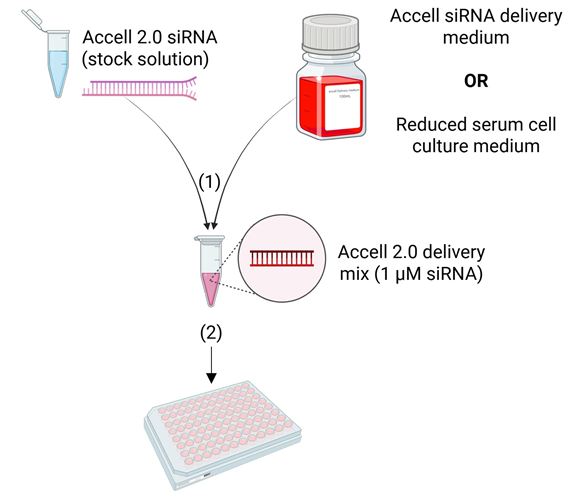
Application of Accell 2.0 siRNA simplifies targeted gene knockdown

- Combine Accell 2.0 siRNA with Accell siRNA delivery media (or other reduced serum media).
- Add Accell 2.0 delivery mix directly to cells and incubate for 72 hours.
Figure created in with BioRender.com
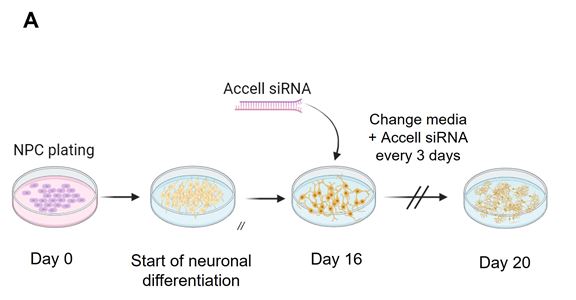
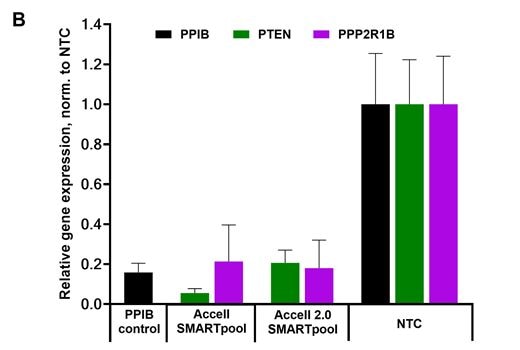
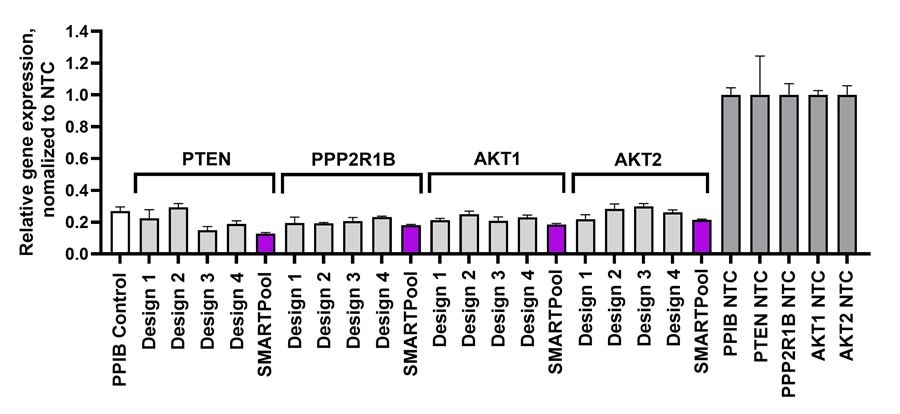
Accell 2.0 siRNA maintains performance of gene target knockdown set by Accell siRNA in neurons derived from induced WTC-11 iPSC cells
|
|
Characterization of target mRNA knockdown by Accell and Accell 2.0 siRNAs in cultured neurons. Data are shown relative to neurons treated with non-targeting control (NTC) siRNA. Experimental schematic (A) and relative gene expression in WTC-11-derived neurons (B). Neurons derived from WTC-11 iPSCs were cultured in differentiation medium for 14 days, with daily medium replenishment. On day 14, 50 µL of medium was removed and replaced with 50 µL fresh medium containing 2 µM Accell or Accell 2.0 pooled siRNA designs (4 siRNA designs at 0.5 µM each) or 2 µM Accell PPIB control (Cat# D-001920-01), resulting in a final siRNA concentration of 1 µM in all conditions. An identical concentration of Accell Non-targeting Control siRNA #1 (D-001910-01) was used for each target NTC condition. siRNA mixtures were replenished by half-medium change on differentiation days 16 and 18, for a total of three siRNA additions. Total RNA was extracted on differentiation day 20 for downstream processing. Figure A is created with BioRender.com.
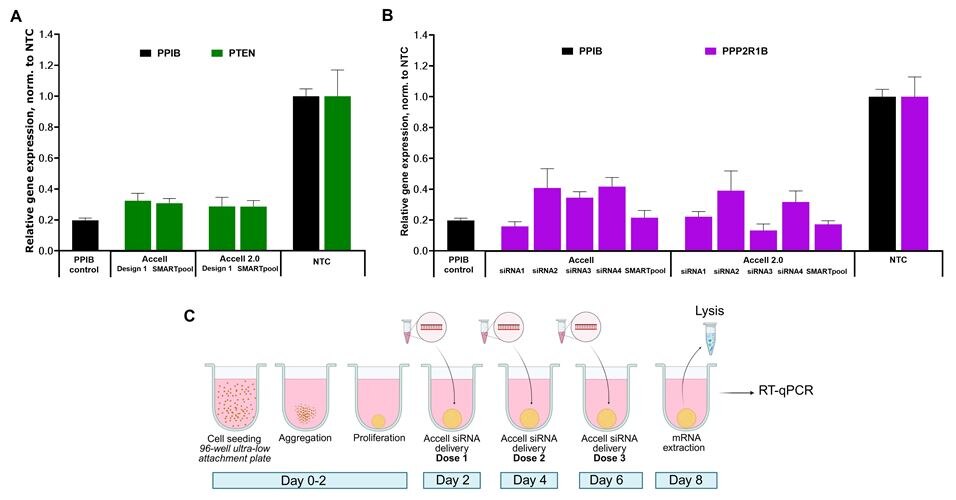
Performance of target mRNA knockdown in matrix-free 3D spheroids is maintained with Accell 2.0 siRNA

Characterization of Accell and Accell 2.0 siRNA-mediated mRNA knockdown in ECM-free HCT-116 spheroids. Control, PTEN (A), and PPP2R1B (B) mRNA expression were quantified in HCT-116 spheroids after 144 hours of siRNA treatment. (C) Dosing timeline for Accell 2.0 siRNA delivery. Spheroids were generated by seeding 3,000 HCT-116 cells into ECM-free, 96-well ultralow attachment round-bottom plates in HCT-116 medium (McCoy’s 5A medium supplemented with 10% FBS and 2 mM L-glutamine). After two days, 50% of the medium was removed and replaced with 2 µM Accell or Accell 2.0 single or pooled siRNA designs (4 siRNAs at 0.5 µM each) for a final concentration of 1 µM siRNA. Matching concentrations of Accell Non-targeting Control siRNA #1 (D-001910-01) or Accell PPIB control siRNA (D-001920-01) were added on the same schedule. After three rounds of siRNA replenishment, spheroids were lysed, total nucleic acid was collected, and RT-qPCR was used to measure target mRNA abundance. Data are shown relative to target expression in spheroids treated with non-targeting control siRNA. Figure C is created with BioRender.com.
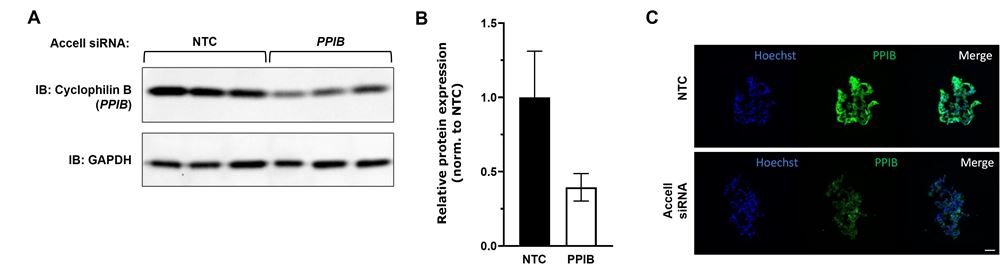
Target protein knockdown in matrix-free 3D spheroids using Accell 2.0 siRNA

Characterization of Accell siRNA-mediated cyclophilin B (PPIB) target protein knockdown in ECM-free HCT-116 spheroids. Data are presented relative to expression in spheroids treated with non-targeting control (NTC) siRNA. (A) Western blot and (B) quantification of Cyclophilin B protein expression in HCT-116 spheroids determined from (A) after 144-h siRNA treatment. Each lane is representative of an independent pool of spheroids (N=3). (C) Immunocytochemistry images of serially sectioned HCT-116 spheroids after 144-h siRNA treatment with an Accell PPIB Control Pool or NTC Pool. Spheroids were then collected, fixed in 2% paraformaldehyde, embedded in optimal cutting (O.C.T.) temperature compound, flash frozen, and serially sectioned. Material was incubated with 1:200 dilution of primary antibody against PPIB (anti-cyclophilin B, Abcam ab16045) and secondary incubation with 1:500 dilution of Alexa 488-conjugated Goat-anti-rabbit antibody (Invitrogen A11034) and 1:1000 dilution of Hoechst 33342 (Molecular Probes H-3570). Scale bar = 200 µM.
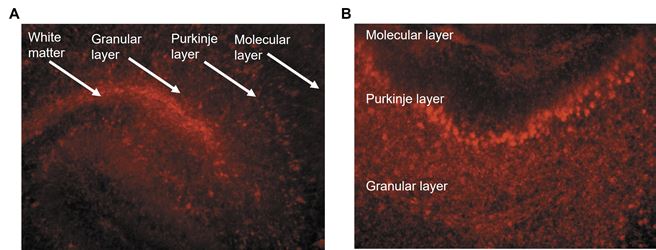
Accell control siRNA demonstrates effective uptake and silencing in organotypic brain slices
Accell siRNA shows increased uptake with extended incubation. 250 µM cerebellar sections were prepared, cultured, and incubated for 3 hours (A) and 72 hours (B) with Accell Red Non-targeting control (NTC) siRNA (Cat# D-001960-01-05) before inspection by microscopy.
Robust gene target knockdown in primary lung fibroblasts using Accell 2.0 siRNA

Application notes
Posters
Product data
Product inserts
Reading lists
Safety data sheets
Selection guides
Related Products
Validated positive control pool of four siRNAs targeting the Cyclophilin B (PPIB) housekeeping gene in human, mouse, or rat. Accell siRNA requires no transfection reagent or viral vector for delivery into difficult-to-transfect cells.
Catalog ID:D2-001920-10-05
Unit Size:5 nmol
$269.00
Accell 2.0 GAPD Control Pool is a set of four siRNAs targeting the GAPD (GAPDH) housekeeping gene in human and mouse. This positive control pool is designed to support evaluation of siRNA delivery and RNAi activity.
Catalog ID:D2-001930-10-05
Unit Size:5 nmol
$269.00
Accell 2.0 Non-targeting Control Pool is a set of four siRNAs designed to support assessment of baseline cellular responses to Accell siRNA treatment.
Catalog ID:D2-001910-10-05
Unit Size:5 nmol
$269.00
An enriched, serum-free media for use during Accell 2.0 siRNA application. While not required for use with Accell 2.0 siRNA, this media provides appropriate serum-free conditions for Accell uptake while maintaining cell health.
Catalog ID:B-005000-500
Unit Size:500 mL