




Accell™ 2.0 siRNA: Transfection-free gene silencing reagents aligned to the evolving transcriptome
Staying current with genomic science
The human genome is vast; billions of nucleotides, thousands of genes, and an ever-growing list of transcripts that define our fundamental understanding of cell regulation and disease mechanisms. For researchers trying to understand gene function and regulation this increasing complexity requires parallel developments in the technologies used to study these phenomena.
The Dharmacon reagents team has spent over two decades designing siRNA reagents for functional genomics, target validation, and translational research. Developing the best-in-class reagents for gene modulation starts with accurate and current reference data, which is why our siRNA designs are built on curated NCBI RefSeq annotations. RefSeq defines gene structures and transcript boundaries, setting an essential foundation for designing reagents that hit the right target.
Accell 2.0 builds on this foundation by using an updated design algorithm that accounts for the landscape of modern reference transcriptomes. Every siRNA is checked against current, biologically relevant transcript definitions, reducing the risk of missing isoforms or hitting off-target sequences. The self-delivering chemistry hasn't changed, and that's intentional. Accell's passive uptake has demonstrated success across difficult cell types. What's new is the improved precision behind every design so researchers can trust delivery and targeting to be functional and specific.
The evolving transcriptome and why reference genome alignment matters
The RefSeq database has grown to cover approximately 175,000 human transcripts with increasingly detailed isoform complexity, refined transcript boundaries, and regulatory nuances that didn't exist in earlier annotations. Accell 2.0 is built directly on these latest RefSeq annotations, ensuring every siRNA targets the most current and biologically relevant transcript definitions (Figure 1).
Transcript annotations don't stand still. As RefSeq evolves, refining canonical records, identifying alternative isoforms, and redefining gene boundaries based on new evidence, Accell 2.0 siRNAs are incrementally realigned to keep pace. This refinement results in more consistent target knockdown, increased confidence in experimental phenotype, and reproducible outcomes across a wide range of cell models.
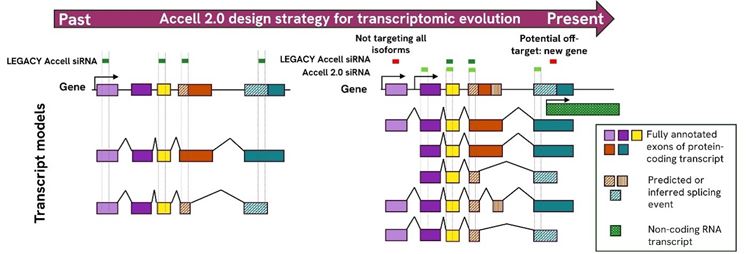
Figure 1 – Depicts the expansion of transcript isoforms enabled by advances in sequencing technology and illustrates how Accell 2.0 siRNA remains aligned to the updated RefSeq to ensure accurate, current targeting.
Transfection-free delivery: A distinct advantage
Unlike conventional siRNA products that rely on lipid-based transfection reagents, viral vectors, or electroporation instruments, Accell 2.0 siRNA enters cells without the need of additional components. This self-delivering mechanism is enabled by novel chemical modifications incorporated into each siRNA duplex, which facilitate cellular uptake, improve stability, and maintain on-target silencing efficiency, without the toxicity often associated with transfection reagents.
This capability is particularly useful for cell types that have historically been out of reach for RNAi experiments. Primary neurons, immune cells, and other difficult-to-transfect models present significant barriers to conventional delivery methods. Accell 2.0 siRNA removes those barriers, enabling gene silencing experiments in biological systems that most closely mirror in vivo physiology.
The stabilizing modifications incorporated into Accell 2.0 siRNA are designed with chemical properties that may facilitate adaptation for pre-clinical research applications; however, additional formulation and optimization steps are recommended before use in animal models
Isoform-aware siRNA design for the evolving transcriptome
Advances in RNA-seq technologies, improved transcript annotations, and the discovery of alternative promoters and splice variants have dramatically expanded our understanding of the transcriptome. As a result, the number of annotated transcript isoforms for many genes has increased substantially over time. For example, in 2010, PTEN and PPP2R1B were annotated with only 1 and 2 transcripts, respectively, compared with 3 and 24 transcripts today. These examples illustrate that transcript annotation growth can range from modest increases to more than a 10-fold expansion, highlighting the increasing complexity of transcriptomes and the importance of designing reagents that account for evolving transcript diversity.
As transcript diversity continues to grow, effective siRNA design requires careful consideration to ensure comprehensive coverage of relevant isoforms while maintaining high target specificity and minimizing cross-target effects. The RNAi SMARTselection™ algorithm used for Accell 2.0 integrates transcriptome-wide annotation data to identify highly specific, functionally potent siRNA sequences that maximize transcript coverage while minimizing off-target activity.
To evaluate performance in difficult-to-transfect cell types, Accell 2.0 siRNAs targeting PTEN and PPP2R1B were tested in iPSC-derived neurons (Figure 2A) and human fetal lung fibroblasts (Figure 2B). In both cell models, Accell 2.0 achieved robust target gene knockdown, demonstrating potent functional activity and effective gene silencing in challenging cellular systems.
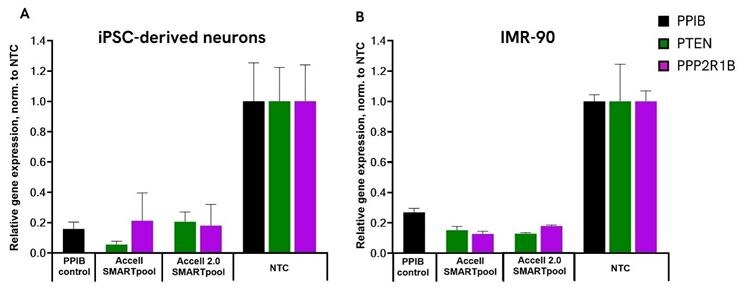
Figure 2. Accell 2.0 maintains high performance of delivery and target gene knockdown set by legacy Accell in cultured neuronal cells (A) and fetal lung fibroblast cell line IMR-90 (B).
Why choose Accell 2.0 siRNA?
Accell 2.0 siRNA is a re-engineered self-delivering siRNA that updates the proven Accell chemistry with the latest RefSeq annotations, so designs track today’s transcriptome and deliver broader, more accurate coverage across genes and isoforms. This tighter alignment improves confidence that resulting phenotypes accurately reflect on-target gene knockdown, simplifies data interpretation, and supports seamless integration into existing RNAi, CRISPR, and multi-omics workflows from focused gene studies in primary cells to high-throughput screening and mechanistic follow-up.
Researchers can continue to trust their legacy Accell siRNA results while adopting Accell 2.0 siRNA, built on the most current genomic data, to keep RNAi experiments in difficult-to-transfect systems precise, interpretable, and consistent with up-to-date advances in transcriptomics.
Quick facts – Accell 2.0
What is the difference between legacy Accell siRNA reagents and Accell 2.0 siRNA?
Accell 2.0 siRNA is a next-generation upgrade of the original Accell self-delivering siRNA. It features improved design algorithms, incremental transcriptome realignment, and updated sequence ranking to enhance specificity, minimize off-target effects, and ensure consistent gene knockdown. Legacy Accell siRNA designs were based on earlier transcriptome data and do not include these ongoing optimizations.
Are there any differences between legacy Accell and Accell 2.0 siRNA beyond sequence alignment to the latest RefSeq?
A: Yes, and importantly, the differences are limited to the siRNA sequences only.
| Feature | Accell | Accell 2.0 |
|---|---|---|
| Chemical modification pattern | Unchanged | Unchanged |
| Synthesis process | Unchanged | Unchanged |
| Sequence design | Legacy transcriptome data | Latest RefSeq annotations |
| Isoform coverage | Limited to original annotation | Maximized coverage across known isoforms |
| Off-target minimization | Limited to original annotation | Enhanced via updated transcriptome data |
Because the chemistry and synthesis are identical, Accell and Accell 2.0 siRNAs are fully compatible for side-by-side use in the same experiment, making direct comparisons straightforward and results directly interpretable.
Is there a price premium on Accell 2.0 siRNA?
No. Accell siRNA 2.0 is priced in line with legacy Accell siRNA. Customers receive additional benefits at the same cost.
How does Accell 2.0 siRNA achieve delivery without transfection reagents?
Accell 2.0 siRNA incorporates novel chemical modifications that enable autonomous cellular uptake. These modifications facilitate entry into cells without lipid reagents, viral vectors, or instrumentation, and are compatible with a wide range of cell types including neurons, immune cells, and primary cells.
How does Accell 2.0 siRNA reduce off-target effects?
Each siRNA is designed using updated transcriptome data and advanced ranking algorithms that prioritize specificity. Seed-region optimization and refined design parameters, informed by the latest RefSeq annotations, help minimize unintended interactions with non-target genes.
Are Accell 2.0 siRNAs guaranteed to knock down my target gene?
Yes. Accell 2.0 siRNA SMARTpool™ reagents and 3 of 4 individual siRNAs are backed by a guaranteed gene knockdown standard, ensuring consistent and dependable performance when used under recommended conditions.
In what formats are Accell 2.0 siRNAs available?
Accell 2.0 siRNA is offered as individual siRNAs or as SMARTpool™ reagents (a blend of four siRNAs targeting the same gene). Plate-based formats are available to support screening workflows.
Can Accell 2.0 siRNA be used in high-throughput or automated platforms?
Yes. Accell 2.0 siRNAs are available in formats compatible with automated systems, including plates suitable for high-throughput applications.
Are Accell 2.0 siRNAs available for multiple species?
Yes. Pre-designed Accell 2.0 siRNAs are available for human, mouse, and rat gene targets.
What are the key experimental considerations for Accell 2.0 siRNA?
Accell 2.0 siRNA works at a higher concentration than conventional siRNA; a recommended 1 µM working concentration is advised. Delivery may be inhibited by BSA present in serum. Optimization with serum-free media formulations (Accell Delivery Media) or less than 2.5% serum in standard media is recommended.
Can Accell 2.0 siRNA be used alongside Edit-R CRISPR reagents?
Yes. Accell 2.0 siRNA serves as an ideal orthogonal method to validate CRISPR screening hits or complement gene knockout studies with gene knockdown testing, particularly in cell types where CRISPR delivery is also challenging.
Is Accell 2.0 siRNA appropriate for in vivo use?
Yes. The stabilizing chemical modifications incorporated into Accell 2.0 siRNA make it suitable for in vivo applications supporting preclinical research in animal models.