





Staying current with Genomic Science
The human genome comprises approximately six billion DNA nucleotides distributed across 23 pairs of chromosomes, encoding the biological processes underlying health and disease. As genomic science accelerates, the tools for probing gene function must evolve to match this. At Revvity’s Dharmacon™ reagents team, we develop tools that enable precise genome interrogation and modulation to support functional genomics, target validation, and translational research. Central to this effort is the accuracy and currency of the reference data used to design genomic reagents.
Dharmacon’s siRNA designs integrate curated RefSeq annotations from the National Center for Biotechnology Information (NCBI) with a proprietary Dharmacon design algorithm1. Because RefSeq defines gene structures and transcript boundaries, it serves as a critical data source for selecting RNAi designs that specifically target the gene of interest. As transcript annotations continue to evolve, aligning siRNA designs with the latest bioinformatic and biological knowledge ensures sustained accuracy, confidence, and reproducibility.
The evolving transcriptome and why RefSeq alignment matters
Advances in sequencing technologies and data curation have dramatically expanded RefSeq to approximately 175,000 human transcripts, uncovering increased isoform complexity, regulatory nuances, and refined transcript boundaries across protein-coding genes. ON-TARGETplus™ 2.0 leverages these advances by directly incorporating the latest RefSeq annotations into siRNA design, ensuring reagents target the most current and biologically relevant transcript definitions (Figure 1). As transcript annotations continue to evolve whether by refining canonical records, elevating alternative isoforms, or redefining gene boundaries based on new evidence; ON TARGETplus 2.0 siRNAs stay aligned with the latest RefSeq to maintain precise, up to date targeting. This alignment supports superior transcript coverage and dependable target engagement, resulting in more consistent knockdown, clearer phenotypes, and highly reproducible outcomes, particularly in large scale screens and hit validation workflows.[
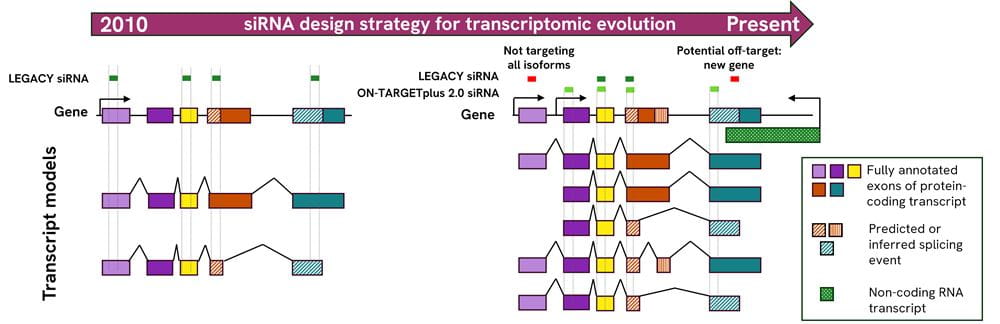
Figure 1 - Depicts the expansion of transcript isoforms enabled by advances in sequencing technology and illustrates how ON TARGETplus 2.0 siRNA remains aligned to the updated RefSeq to ensure accurate, current targeting.
ON-TARGETplus 2.0: Updated design strategy
ON-TARGETplus 2.0 employs a refined design strategy that prioritizes targeting each gene’s primary (canonical) transcript while striving for broad coverage of additional annotated isoforms. This approach enables a more comprehensive coverage of the protein-coding genome while maintaining high specificity and biological relevance. Importantly, the proven Dharmacon design algorithms and proprietary chemical modification patterns remain unchanged. Potency, specificity, and off-target reduction continue to define ON-TARGETplus performance; the advancement lies in bioinformatically updating the sequence selection.
Gene-level improvements enabled by updated annotation
The impact of updated transcript alignment is evident in genes with increasing isoform complexity. For example, ON-TARGETplus 2.0 designs for the DNAH9 gene achieve expanded transcript coverage with improved specificity by eliminating short and incomplete transcripts (Figure 2). Similarly, redesigned siRNAs for genes such as SYPL2 demonstrate enhanced selectivity towards the primary transcript by avoiding unintended interactions with unrelated genes, improving interpretability and experimental confidence. These examples highlight how updated annotations enable more precise targeting without altering the core performance characteristics researchers depend on.
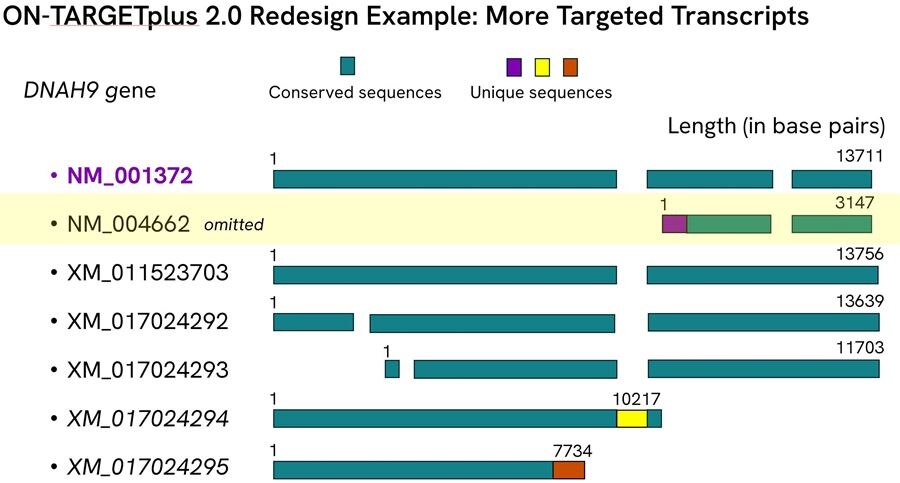
Figure 2 – Depicts the current ON-TARGETplus design pick strategy improving siRNA design for genes like DNAH9 by expanding coverage of full length isoforms and removing incomplete variants, enabling more precise and reliable targeting.
Why choose ON-TARGETplus 2.0?
ON-TARGETplus 2.0 is a re engineered siRNA portfolio that updates the proven ON-TARGETplus chemistry with the latest RefSeq annotations so designs track today’s transcriptome, giving broader and more accurate coverage across genes and isoforms. This tighter alignment improves confidence that phenotypes truly reflect on target gene knockdown, simplifies data interpretation, and plugs smoothly into existing RNAi, CRISPR, and multi omic workflows - from focused gene studies to high-throughput screening and mechanistic follow-up through orthogonal validation of findings . Researchers can keep trusting their legacy ON-TARGETplus results while adopting ON-TARGETplus 2.0, built on the most current genomic data, to keep RNAi experiments precise, interpretable, and ready for future advances in genomics.
References
- National Center for Biotechnology Information. About RefSeq. NCBI RefSeq. Retrieved 09/02/2025 from https://www.ncbi.nlm.nih.gov/refseq/about/
For additional questions, guidance, or support, please contact our Scientific Support team at technical.horizon@revvity.com. For additional information on how realignment is important for your research, see Part 1 of our Realigning and Remapping Dharmacon research tools series.
Quick facts – ON-TARGETplus 2.0
- What is the difference between the legacy ON-TARGETplus reagents and ON-TARGETplus 2.0?
A: ON-TARGETplus 2.0 is a next-generation upgrade of the original ON-TARGETplus siRNA. It features improved design algorithms, continuous transcriptome realignment, and updated sequence ranking to enhance specificity, minimize off-target effects, and ensure consistent gene knockdown. In contrast, legacy ON-TARGETplus designs were based on earlier transcriptome data and do not include these ongoing optimizations. - Is there a price premium on ON-TARGETplus 2.0?
No. ON-TARGETplus 2.0 is priced in line with legacy ON-TARGETplus. Customers get additional benefits at the same cost. - How does ON-TARGETplus 2.0 reduce off-target effects?
Each siRNA is designed using updated transcriptome data and advanced ranking algorithms that prioritize specificity. Seed-region optimization and refined design parameters help minimize unintended interactions. - Are ON-TARGETplus 2.0 siRNAs guaranteed to knock down my target gene?
Yes. ON-TARGETplus 2.0 siRNAs are backed by a guaranteed gene knockdown standard, ensuring consistent and dependable performance when used under recommended conditions. - In what formats are ON-TARGETplus 2.0 siRNAs available?
ON-TARGETplus 2.0 is offered as individual siRNAs or as SMARTpool reagents (a blend of four siRNAs targeting the same gene). Plate-based formats are available to support screening workflows. - Can ON-TARGETplus 2.0 be used in high-throughput or automated platforms?
Absolutely. ON-TARGETplus 2.0 siRNAs are available in formats compatible with automated systems, including plates suitable for high-throughput applications.