




- Dharmacon Screening libraries
- crispri-lentiviral-sgrna-pooled-library
CRISPRmod CRISPRi Lentiviral sgRNA Pooled Screening Libraries
Whole genome, druggable genome, gene family and pathway libraries for performing CRISPR interference (CRISPRi) repression screening. Each sgRNA library should be paired with a dCas9-effector for CRISPRi, such as dCas9-SALL1-SDS3.
If co-expression of the sgRNA and dCas9-SALL1-SDS3 in a single vector is desired, CRISPRmod CRISPRi All-in-one Lentiviral sgRNA Whole Genome Pooled Libraries are also available for CRISPRi screening in a single transduction.
Perform CRISPRi gene repression screens with CRISPRmod CRISPRi lentiviral sgRNA libraries

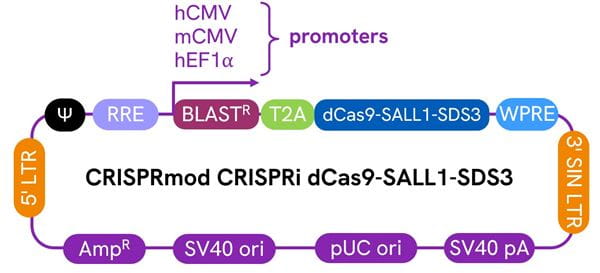
The CRISPR interference (CRISPRi) system is a unique adaptation of the classical CRISPR-Cas9 gene editing system which utilizes a catalytically deactivated or dead S. pyogenes Cas9 (dCas9) that is fused to one or more transcriptional repressors. The DharmaconTM CRISPRmodTM CRISPRi system utilizes a catalytically deactivated Cas9 (dCas9) fused to our proprietary transcriptional repressors SALL1 and SDS3. When paired with a well-designed guide RNA that targets a gene near a promoter region, or transcriptional start site (TSS), it induces transcriptional repression. The CRISPRmod CRISPRi lentiviral sgRNA pooled screening libraries utilize sgRNA designs from a published algorithm by Horlbeck, et. al. 2016 that demonstrates strong levels of gene inhibition from optimized designs.
|
CRISPRmod CRISPRi lentiviral sgRNA library scaffold shown (left). |
|
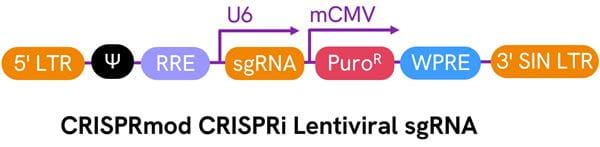
Highlights:
- High quality, purified, concentrated ≥ 5 x 10⁸ TU/mL (± 20%) lentiviral particles in 10 x 100µL pack sizes.
- Rationally designed lentiviral sgRNAs mediate efficient and specific gene inhibition.
- Deep and broad coverage of 4 or 8 sgRNAs per gene across the human genome for whole genome libraries, or 4 sgRNAs per gene for gene family and pathway libraries.
- 16 different predefined gene family and pathway libraries for targeted screening applications. Contact Scientific Support for more information regarding gene composition of these libraries, or email us at sales.horizon@revvity.com for ordering custom CRISPRi lentiviral sgRNA pooled screening libraries.
- Gene family and pathway libraries include up to 136 gene-specific sgRNA technical controls targeting up to 34 protein-coding genes (4 sgRNA per gene); including common reference genes (ACTB, GAPDH, LAMB1, & PPIB).
- Up to 100 non-targeting gRNA negative controls bioinformatically confirmed to not align with (target) any gene in the human genome.
- A data file containing complete library information, including: gene annotations, sgRNA target sequences, complete list of controls, and counts per millions of mapped reads.
Products recommended in our validated protocol:
- Vector-matched CRISPRi lentiviral positive and non-targeting sgRNA controls for gene repression validation and experimental optimization.
- dCas9-SALL1-SDS3 lentiviral reagents available in constitutive or Strict-R dual-inducible formats.
-
NGS Library Prep Kit designed to amplify and sequence sgRNA constructs from gDNA without bias from the CRISPRmod CRISPRi lentiviral sgRNA library vector backbone.
- Primer set options available in two different sizes for 12 or 24 whole genome screens.
- One complete solution for sequencing on an Illumina® platform without the need for additional reagents.
See our CRISPRi applications page for an overview of the technology.
See our All-in-one pooled CRISPR screening to accelerate drug discovery, development, and pathway analysis Application Note for more information on CRISPRi repression screening.
See our CRISPR interference reagents page for constitutive and Strict-R inducible dCas9-SALL1-SDS3 lentiviral reagents to use alongside CRISPRmod CRISPRi lentiviral sgRNA libraries.
See our scientific poster for examples using the gene pathway and family libraries for high throughput single cell CRISPR analysis.
Important Notice
The CRISPRmod CRISPRi Lentiviral sgRNA Pooled Libraries are solely for internal research use (as set forth in the Product Terms and Conditions) in laboratories where the containment measures stated below and in applicable laws and regulations are met. Products may not be used for diagnostic, therapeutic or other commercial purposes and may not to be administered to humans for any purpose or to animals for therapeutic purposes. CRISPRi Lentiviral sgRNA Pooled Libraries provided as lentiviral particles are replication-incompetent, self-inactivating (SIN) and non-pathogenic (do not cause infectious human disease).
Any investigator who purchases lentiviral particle products is responsible for consulting with their institution's health and biosafety personnel for specific guidelines on the handling of lentiviral vector particles. Furthermore, each investigator is fully responsible for obtaining the required permissions for research using and the acceptance of replication-incompetent SIN lentiviral vectors and replication-defective lentiviral particles into their local jurisdiction and institution.
Please contact Scientific Support for more information
Approximate number of targeted genes in CRISPRmod CRISPRi lentiviral sgRNA pooled screening libraries. Please reach out to Scientific Support for more information regarding gene composition of each library.
| Whole Genome | 18,900 |
| Druggable Genome | 8,350 |
| GPCRs | 480 |
| Ion Channels | 430 |
| Protein Kinases | 760 |
| Phosphatases | 310 |
| Proteases | 700 |
| Ubiquitin Conjugate | 660 |
| Epigenetics | 860 |
| Cytokine Receptors | 140 |
| Membrane Trafficking | 140 |
| Deubiquitinating Enzymes | 110 |
| Cell Cycle Regulation | 170 |
| Tyrosine Kinases | 90 |
| Nuclear Receptors | 50 |
| Apoptosis | 550 |
| DNA Damage Response | 240 |
Volume of lentiviral particles required for screening with CRISPRmod CRISPRi lentiviral sgRNA whole genome pooled screening libraries
| Fold representation | Replicates | sgRNAs per gene | Volume of lentiviral particles |
|---|---|---|---|
| 200 | 2 | 4 | 0.07 mL |
| 200 | 2 | 8 | 0.13 mL |
| 400 | 2 | 4 | 0.13 mL |
| 400 | 2 | 8 | 0.25 mL |
Volume of lentiviral particles at 5 × 10⁸ TU/mL in HEK293T cells required for the indicated fold representation, biological replicates, and sgRNAs/gene, assuming experimental cells have same relative transduction efficiency as HEK293T. The volume of lentiviral particles required for your screen can be calculated using the CRISPR pooled screening protocol tracking worksheet
| NGS Library Prep Kit Contents | Small: 12 Whole Genome Screens | Large: 24 Whole Genome Screens |
|---|---|---|
| NEXTFLEX® PCR Master Mix (green cap) | 3600 μL | 7200 μL |
| Dharmacon HIT Identification Primers (orange cap) | 300 μL | 600 μL |
| NEXTFLEX® PCR II Barcoded Primer Mix | 4 μL | 4 μL |
| Resuspension Buffer | 12 mL | 24 mL |
| Nuclease-free water | 8 mL | 16 mL |
| Cleanup Beads | 7 mL | 15 mL |
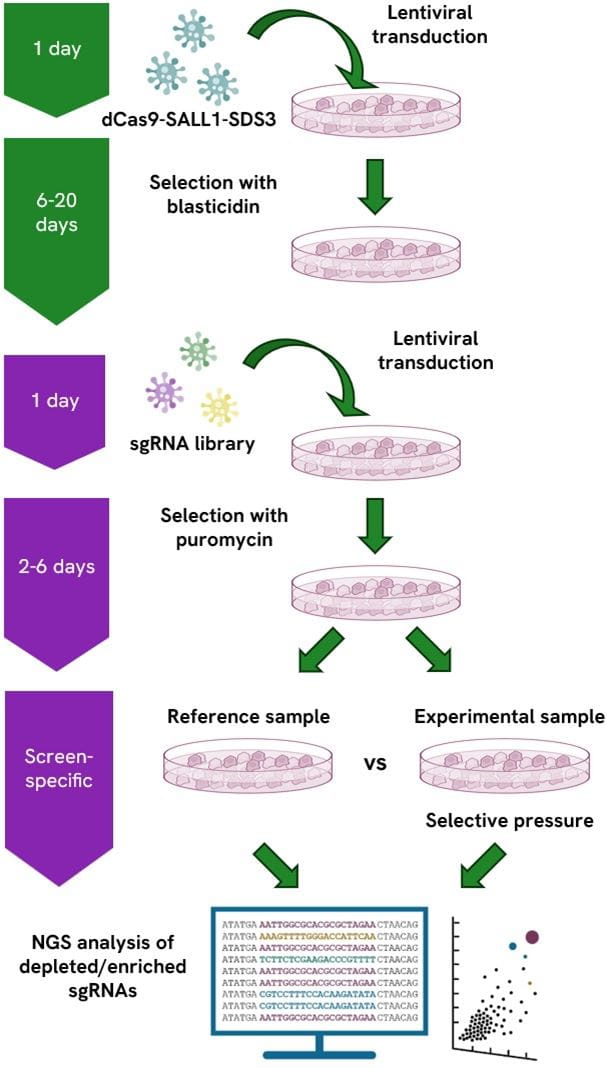
Gene repression screening workflow using the CRISPRmod CRISPRi lentiviral sgRNA pooled screening library platform.

A dCas9-SALL1-SDS3-expressing stable cell line (mixed or clonal cell population) is first generated with CRISPRmod CRISPRi Lentiviral dCas9-SALL1-SDS3 particles by selection with blasticidin. These cells are then transduced with a CRISPRmod CRISPRi lentiviral sgRNA pooled library and selected with puromycin. Transduced cells are split into reference and experimental populations for application of a selective pressure and/or phenotypic selection. Genomic DNA is then isolated from the reference and experimental populations of transduced cells and sgRNA constructs within the isolated gDNA are amplified, indexed, and prepared for high-throughput sequencing on an Illumina platform using the Dharmacon™ NGS Library Prep Kit. The integrated sgRNA sequences in both reference and experimental samples are identified and relative abundance compared. sgRNA constructs that are enriched or depleted are identified as hits to be confirmed and studied further using individual CRISPRmod CRISPRi Lentiviral sgRNAs in additional phenotypic and/or biochemical assays.
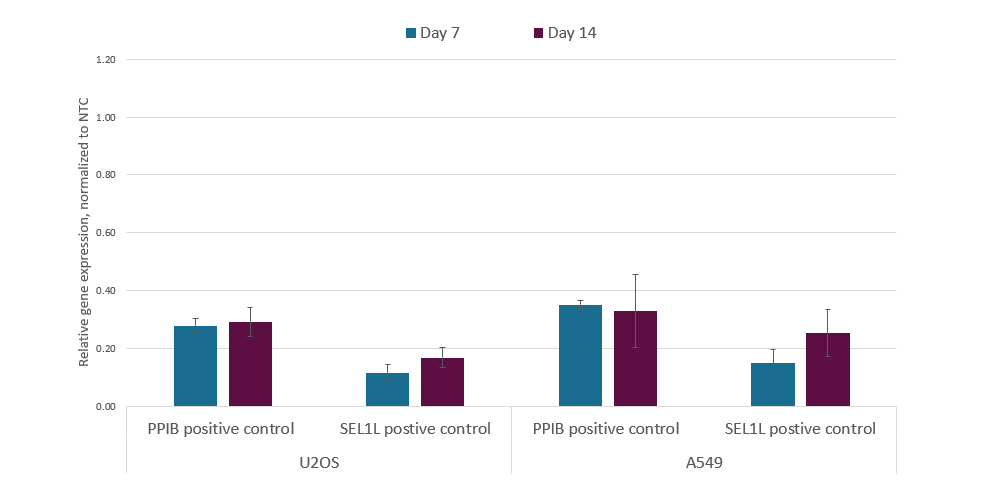
CRISPRi lentiviral sgRNA is well suited for long term repression
Figure 1: U2OS and A549 cells stably expressing integrated dCas9-KRAB or dCas9-SALL1-SDS3 were plated at 50,000 cells/well in 24 well plates and transduced with CRISPRi sgRNA expressing lentiviral particles targeting PPIB or SEL1L at a MOI of 0.3 to obtain cells with a single integrant. Cells were selected with 2 µg/mL puromycin for 5 days, split into two populations, and allowed to recover for an additional day. At 7 days post-transduction one population was harvested for RT-qPCR analysis. The replicate populations of cells were cultured for 7 additional days before harvest. Total RNA was isolated from harvested plates and relative gene expression was calculated with the Cq method using GAPDH as the housekeeping gene and normalized to a non-targeting control.
CRISPRmod CRISPRi lentiviral sgRNA libraries undergo rigorous production and QC for high quality pooled screening
|
|
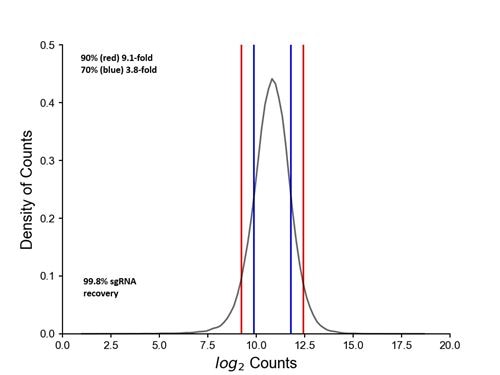
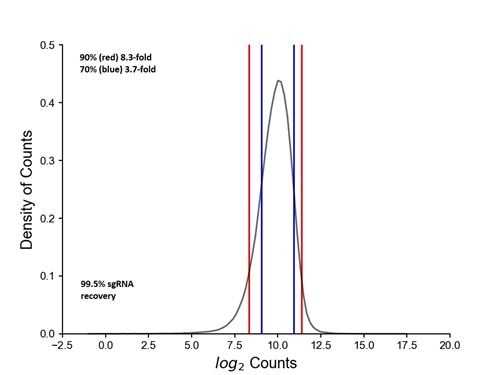
Figure 2: High quality pooled screening begins with rigorous lentiviral pooled library production. CRISPRmod CRISPRi lentiviral sgRNA whole genome pooled libraries comprising 4 sgRNAs per gene (left) and 8 sgRNAs per gene (right) were produced and the quality of the plasmid DNA library was verified by next-generation sequencing (NGS). Counts per million mapped reads were obtained to determine the percent-recovery of input sgRNAs 99.8% (left) and 99.5% (right) and that the distribution of 90% and 70% of the sgRNAs in the pool are within 9.1 (left), 8.3 (right) and 3.8 (left), 3.7 (right) fold of each other, respectively, indicating high sgRNA recovery and uniform distribution of sgRNAs if both the 4 sgRNA per gene and 8 sgRNA per gene whole genome libraries. For more information on skew ratios for genome-wide libraries, please see: https://pmc.ncbi.nlm.nih.gov/articles/PMC10797759/.
Assessment of essential and non-essential gene dropout with the All-in-one dCas9-SALL1-SDS3 CRISPRi system, CRISPRi KRAB system and CRISPRko system

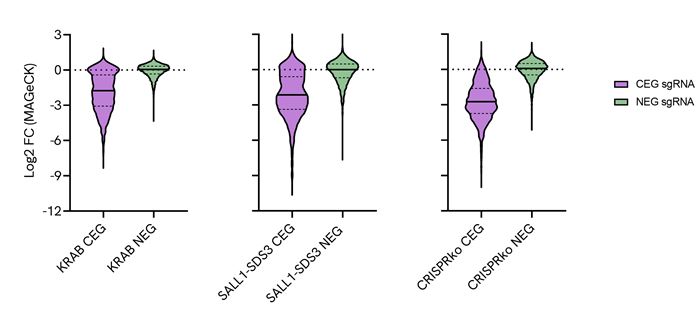
Figure 3: To assess the efficacy of the whole genome loss-of-function screens, we analyzed a subset of guide RNAs that target a group of 684 core essential genes (CEG) and 1000 non-essential genes (NEG) for gene knockout (Cas9) or repression (either dCas9-KRAB or dCas9-SALL-SDS3) in the reference population (DMSO-treated only) of A375 melanoma cells. By assessing the degree of essential “gene dropout” for sgRNA targets that become depleted relative to an initial timepoint, one can establish an unbiased measure of platform performance. Violin plots illustrate the degree of CEG and NEG dropout in the three loss-of-function platforms. Each screening platform exhibits significant essential gene dropout, and neutral non-essential gene behavior, serving to validate the incorporated whole-genome screen in each case. See our full Application Note for more details.
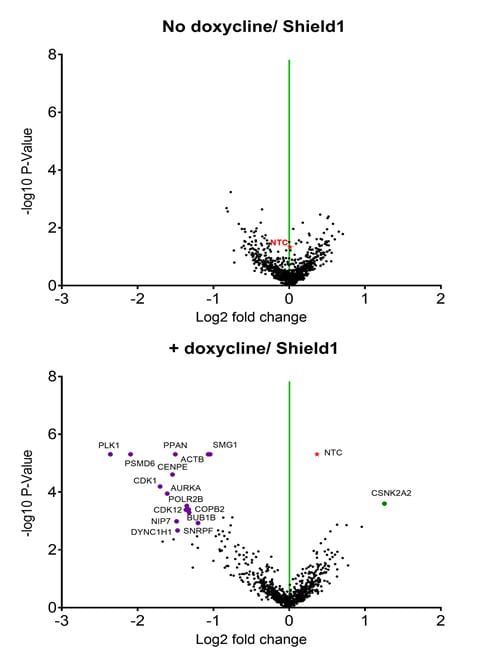
Application example: High-throughput pooled CRISPR screening with high-capacity single cell analysis can be effectively achieved with gene family pathway libraries. These libraries are now available in CRISPRi formats as well, supporting the data and conclusions observed below for CRISPRko screening with a protein kinase sgRNA library of the same gene composition.
|
|
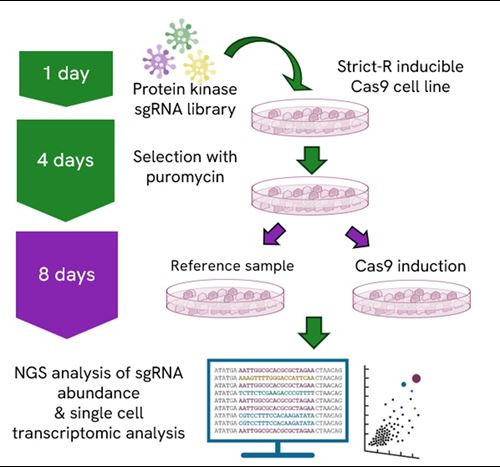
Figure 4: A pooled lentiviral library comprised of 3240 Edit-R sgRNAs targeting 760 human kinases, a small panel of essential genes, and 100 non-targeting controls (NTCs) was transduced into Strict-R inducible Cas9-expressing U2OS and A549 cell lines at MOI of 0.3 and 300- fold sgRNA representation. At 24 hours post-transduction, cells were selected with 2 μg/mL puromycin for 4 days. The reference (T0) sample was harvested, and matched samples were stimulated with 500 ng/µL doxycycline/ 500 nM Shield1 or cultured in standard growth media for 8 days. Genomic DNA was harvested from the T0, uninduced and induced samples and PCR-amplified for high-throughput sequencing on an Illumina platform. Log2 fold change of induced U2OS cells compared to T0 is plotted vs. –log10 MAGeCK P-value. The sgRNAs that were significantly (FDR ≤ 0.10) higher and lower abundance that also showed > |2|-fold abundance change are in green and purple, respectively. NTC abundance is starred in red, and the green line indicates zero-fold abundance change. See our full scientific poster for more details.
Application notes
Product data
Product inserts
Safety data sheets
Related Products
Validated CRISPRi lentiviral sgRNA for optimization of transcriptional repression experiments.
Validated CRISPRi lentiviral sgRNA for evaluation of transcriptional repression experiments.
Perform repression of thousands of genes at the transcriptional level with a single transduction of CRISPRi all-in-one pooled lentiviral library eliminating the need to perform sequential transductions.